
Categories
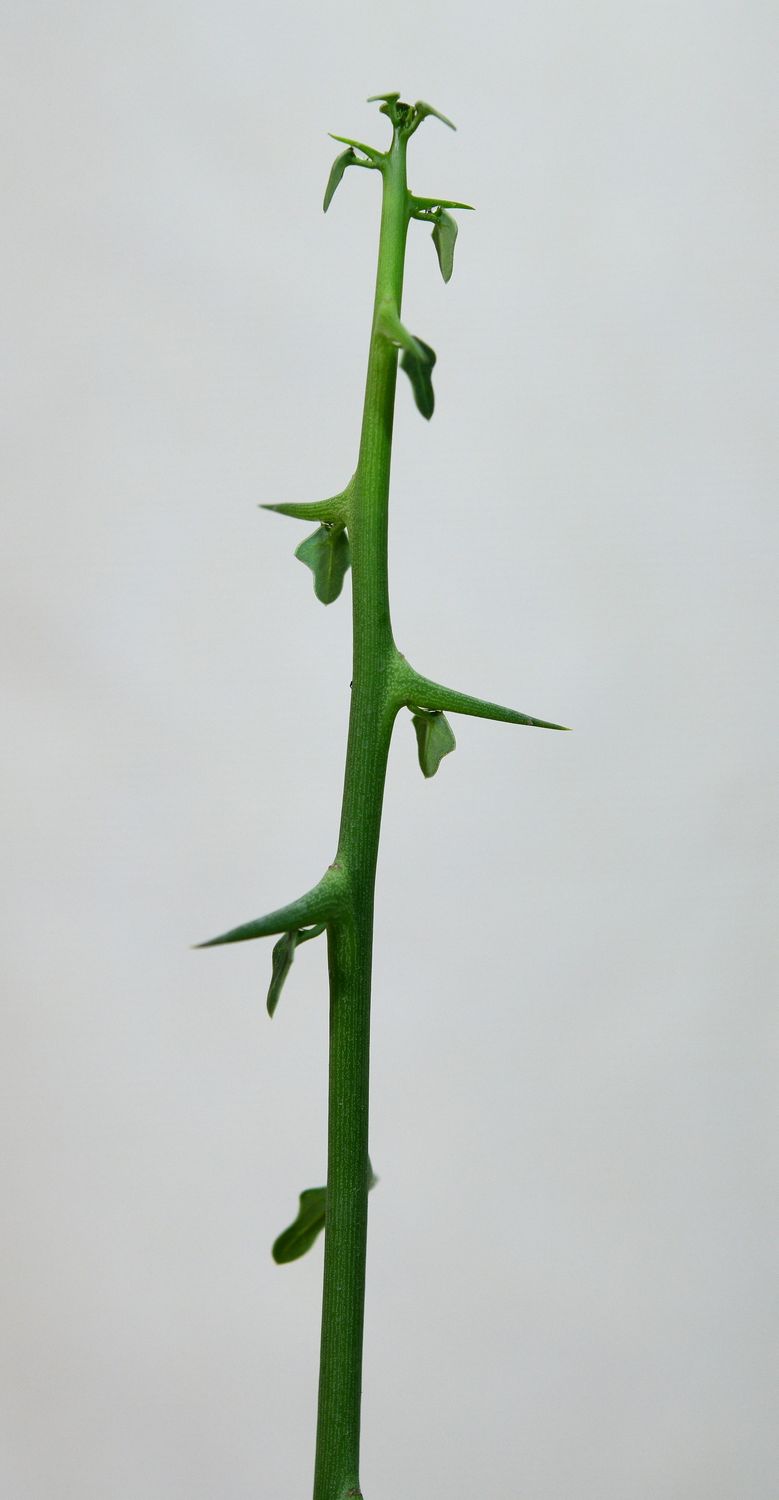
Adenia globosa
SKU PA055
₹550.00
In stock: 1 available
1
Save this product for later
Customer reviews
Reviews only from verified customers
No reviews yet. You can buy this product and be the first to leave a review.
Adenia globosa
Product Details
Rooted Cutting
A slow-built sculpture of a plant — a swollen, warty green globe from the thorn-scrub of the Horn of Africa, sending out a tangle of vicious, spine-armed stems that scramble and climb like something only half-tamed, even in a collector's pot.
Origin of Name
The genus Adenia was established by the Swedish-Finnish naturalist Peter Forsskål, based on a plant he collected in Arabia and named Adenia venenata. Accounts of the name's origin agree on the essentials but differ slightly in the telling: most sources trace it directly to the port city of Aden, in present-day Yemen, where Forsskål gathered the type specimen; others record it as coming from "aden," reported as the local Arabic name for the plant itself. Either way, the genus carries a piece of Red Sea geography in its name. Forsskål's own story adds a layer of poignancy here — he was part of the ill-fated Danish Arabia Expedition of the 1760s and died of fever in Yemen in 1763, with much of his botanical work published only posthumously by the expedition's sole survivor, Carsten Niebuhr.
The species epithet globosa is straightforward Latin for "globe-shaped" or "spherical," describing the swollen, rounded caudex that defines this species within its already caudex-rich genus. Adenia globosa itself was formally described by the German botanist Adolf Engler in 1891, in his own journal, Botanische Jahrbücher für Systematik. Locally in Swahili it's known as mpaga. Taxonomically, the species has since been split into three recognised subspecies — subsp. globosa, subsp. curvata, and subsp. pseudoglobosa — distinguished by branch habit and thorn length rather than by the caudex itself.
Origin of Plant
Adenia globosa is native to the arid scrub savanna of the Horn of Africa and East Africa, with a range running from southern Ethiopia through southern Somalia and into southern Kenya and northern Tanzania. It grows at elevations from roughly 100 to 1,800 metres, rooted in the same hot, thorn-scrub terrain shared by many of the region's other caudex-forming succulents — a landscape defined by long dry seasons and short, intense rains. The species was collected and described during the height of German botanical exploration of East Africa in the late 19th century, a period when Engler and his contemporaries were rapidly documenting the continent's succulent flora for European science.
Description
Adenia globosa is unmistakable even among caudiciforms: a swollen, warty, grey-green trunk that can reach up to 2.5 metres across in the wild, taking on a rounded, almost boulder-like form. From this caudex emerge long, wiry, spine-covered branches — up to 8 metres in length where the plant grows erect or climbs into surrounding vegetation, using tendrils to scramble up neighbouring shrubs and trees. The thorns themselves are formidable, reaching up to 8 centimetres long and set close along the stems.
Leaves are small and almost incidental against the plant's dramatic structure — alternately arranged, no more than 7 millimetres long, either simple and triangular or divided into three shallow lobes, and shed entirely during the dry season as the plant retreats into dormancy. Flowers are greenish-white and modest in size, appearing solitary or in small clusters of up to five in the leaf axils; the species is dioecious, meaning individual plants are either male or female, with noticeably larger flowers on male plants (up to 2 cm, with five stamens) than on female ones (about 1 cm, with three styles). Pollinated flowers give way to a small, leathery, rounded green seed capsule.
Conservation Status
Adenia globosa is currently assessed as Least Concern by the IUCN, reflecting its relatively wide distribution across four countries and its tolerance of the harsh scrub habitats it occupies. It carries no CITES listing. That said, its slow growth and the difficulty of propagating a true caudex from cuttings mean that most collector specimens available in cultivation are grown from seed rather than wild-harvested — a meaningful distinction for a plant this visually dependent on decades of accumulated girth.
Care
Light: Bright light suits the stems and foliage best, though many growers shade the caudex itself, echoing the dappled protection it would receive scrambling through scrub vegetation in the wild.
Watering: A summer grower — water regularly and feed lightly through the warm season while leaves are present, then reduce sharply as the plant drops its foliage and enters dormancy. Keep nearly dry through the cooler months, watering only enough to prevent the caudex from shrivelling.
Soil: A fast-draining succulent or cactus mix is essential; standing moisture around the caudex invites rot quickly.
Temperature: Frost-tender, generally rated for USDA zones 10b–11b (roughly 1–10°C/35–50°F as a minimum). Protect firmly from cold, though the plant can stay in active growth year-round if kept consistently above about 10°C (50°F).
Handling & propagation: The sap contains cyanogenic compounds and should be treated as toxic — handle pruning cuts with gloves and care. Because stem cuttings rarely develop a caudex of their own, propagation is almost always by seed, which requires both a male and female plant to produce viable pods.
An Interesting Note
Beyond its ornamental appeal, Adenia globosa carries real weight in the everyday life of the communities who share its range. The Maasai use it as a veterinary medicine for cattle, and in parts of Kenya the plant has traditionally served a more unexpected purpose: as an aid in water purification. It's a reminder that long before this species became a prized "lump plant" on collectors' shelves worldwide, it was already doing quiet, practical work in the arid landscapes it calls home — proof that a plant can be simultaneously ornamental oddity and genuine survival tool, depending entirely on who's looking at it.
Display prices in:INR
