
Categories
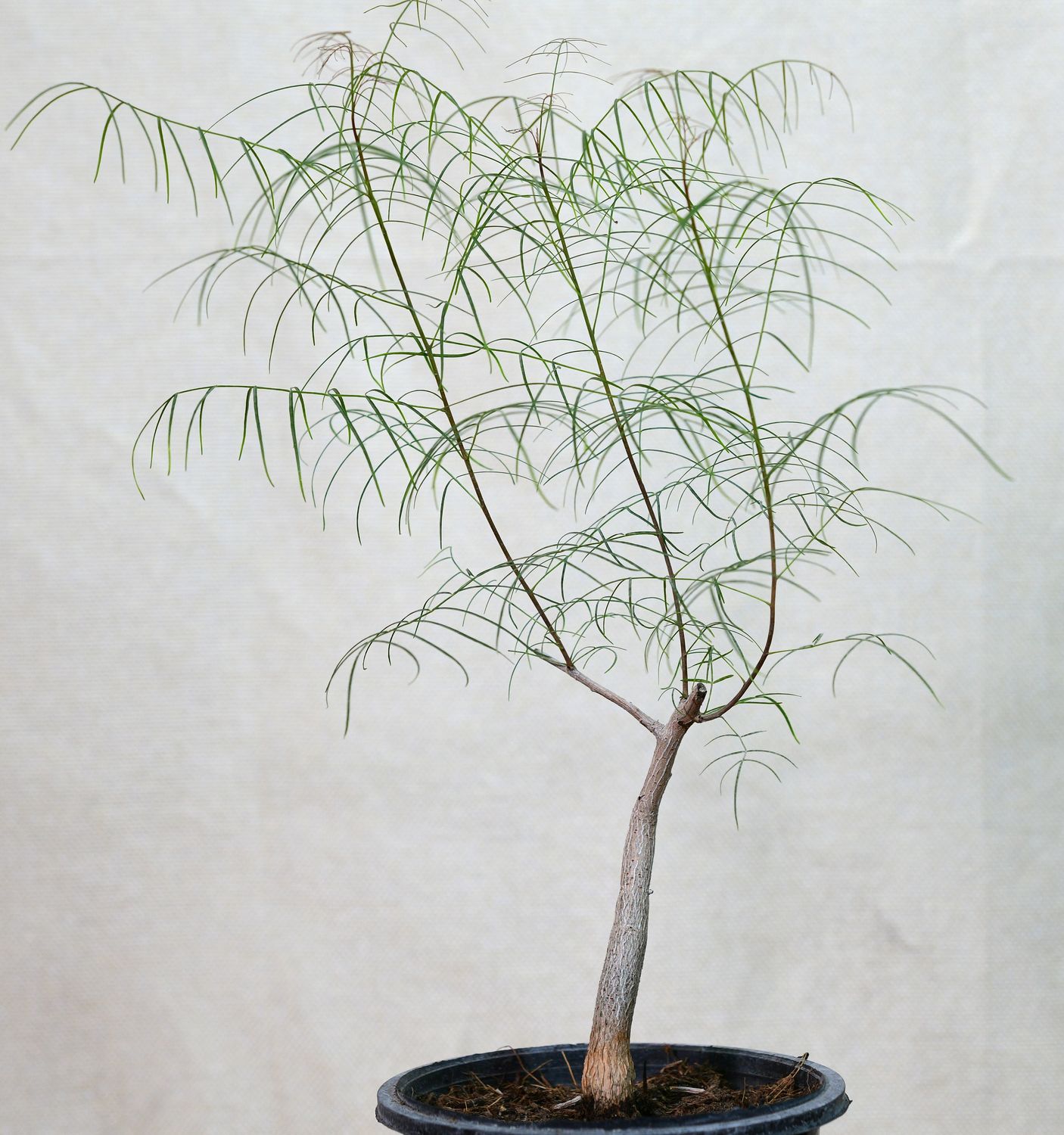
Bursera paradoxa
SKU PA083
₹4 250.00
Sold out
Sold out
Save this product for later
Customer reviews
Reviews only from verified customers
No reviews yet. You can buy this product and be the first to leave a review.
Bursera paradoxa
Product Details
A small, sculptural Mexican tree that has spent nearly half a century confusing its own taxonomists — a species so combinatorially odd that its very name is a shrug of botanical bewilderment, chosen because the plant simply refused to sit neatly in either of its genus's two established camps.
Origin of Name
The genus name Bursera honours Joachim Burser (1583–1649), a German-Swedish botanist whose dried plant collections later informed Linnaeus's own taxonomic work — a fairly conventional botanical dedication, shared with roughly a hundred other species across the genus.
The species epithet is anything but conventional. Bursera paradoxa was described in 1980 by Mexican botanists Francisco Guevara-Fefer and Jerzy Rzedowski, in a paper cataloguing three new Bursera species discovered around the Infiernillo Dam in Michoacán. The authors chose "paradoxa" — from the Greek paradoxos, "contrary to expectation" — for a very specific reason: the plant simply wouldn't classify cleanly. Bursera has long been split into two sections, Bursera and Bullockia, distinguished largely by fruit structure and bark texture. This species' three-valved drupe and three-chambered ovary point firmly to Section Bursera, yet its bark stays smooth and intact on mature trees rather than peeling in papery sheets — a trait that's the calling card of the other section, Bullockia, entirely. Its leaves, meanwhile, are distinctive enough that later researchers have struggled to place them confidently in either group at all. The name records that contradiction honestly, rather than smoothing it into a tidier story.
Origin of Plant
Bursera paradoxa is endemic to Mexico, known only from the states of Michoacán and Guerrero, within the arid, dry tropical deciduous forest of the Balsas Depression — a hot, seasonally parched basin carved by the Balsas River. The type specimen was collected on shallow, rocky soils across gently to moderately sloped hills near the Infiernillo Dam, growing alongside arborescent cacti in classic Mexican dry-forest company. It shares this habitat with several other narrowly endemic species of the region, including Bursera crenata and Bursera sarukhanii — the latter described in the very same 1980 paper as its own new species from the same expedition.
Description
Based on the type material, Bursera paradoxa is a small tree, recorded at roughly 3.5 metres tall, with smooth, greyish-red bark that — unusually for its taxonomic section — does not exfoliate in papery peels as it matures. Like other Burseraceae, it produces a three-valved (trivalvate) drupe fruit developing from a three-chambered ovary. Beyond these type-description details, published horticultural and field data on this species remain genuinely scarce; it's a poorly studied endemic even by the standards of a genus whose members are frequently under-documented, and we'd rather note that gap plainly than pad the description with assumed traits borrowed from better-known Bursera relatives.
Conservation Status
We have not located a formal IUCN Red List assessment for Bursera paradoxa. That absence isn't the same as a clean bill of health: the species is known only from a narrow slice of the Balsas Depression across two Mexican states, a dry-forest habitat type that continues to face pressure from agricultural conversion and grazing across much of its extent in Mexico. Several better-studied relatives within the genus — including Bursera aromatica and Bursera malacophylla — carry Vulnerable ratings for similarly restricted ranges, which gives some sense of the conservation profile a narrowly endemic Bursera like this one is likely to share, even without a formal assessment on record.
Care
Light: Full sun, reflecting its native dry-forest, hillside habitat.
Watering: Water during the warm growing season, allowing the soil to dry between waterings, then reduce sharply as the tree drops its leaves for its natural dry-season dormancy — a pattern shared across virtually the entire genus.
Soil: A gritty, fast-draining mix that mimics the shallow, rocky hillside soils of its native range; avoid anything that holds excess moisture around the roots or trunk base.
Temperature: As a dry tropical forest species from a genus with essentially no frost tolerance, protect firmly from cold and treat as a warm-climate or greenhouse specimen outside frost-free regions.
General tips: Like its Bursera relatives — a genus that includes the sources of copal resin used across Mesoamerica for millennia — expect fragrant, resinous sap if the bark or stems are damaged; handle pruning cuts with care. Given how little is documented about this species in cultivation, treat early growing seasons as an open-ended experiment, and keep notes on what works, since this is unmapped territory even for experienced Bursera growers.
A Story Worth Telling
The detail that makes Bursera paradoxa worth a second look isn't really about Mexico at all — it's about South Africa. In the same 1980 paper that named this species, Guevara-Fefer and Rzedowski noted a striking resemblance between B. paradoxa's leaves and those of Commiphora kraeuseliana, a dry-forest relative in Bursera's own family found only in southwestern Africa, on a continent this plant has never touched. The two species aren't closely related — they simply arrived, independently, at strikingly similar solutions to strikingly similar problems: surviving hot, seasonal drought as a small, deciduous, resin-producing tree. It's a tidy example of convergent evolution playing out across an ocean, and a fitting footnote for a species whose own name already admits that biology doesn't always sort itself into the categories we'd prefer.
Display prices in:INR
