
Categories
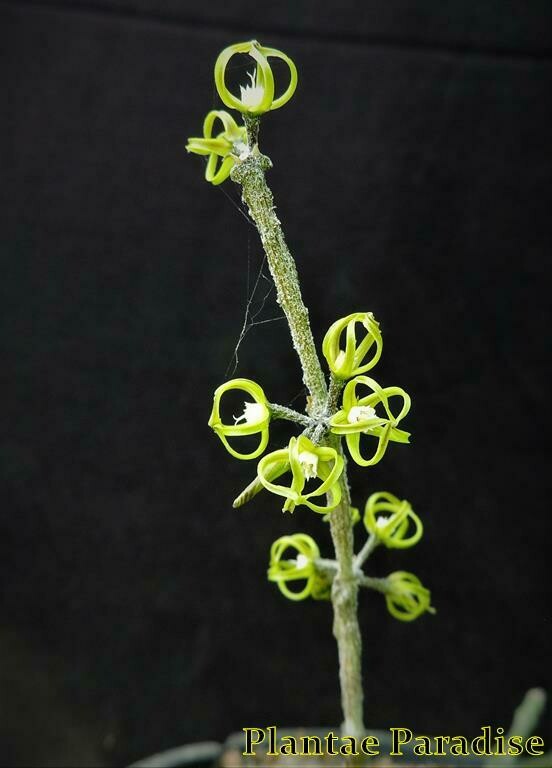
Cynanchum marnierianum
SKU ASC033
₹250.00
In stock: 1 available
1
Save this product for later
Customer reviews
Reviews only from verified customers
No reviews yet. You can buy this product and be the first to leave a review.
Cynanchum marnierianum
Product Details
A tangle of slender, knobbly stems that turns into a shower of tiny lanterns when it flowers. Cynanchum marnierianum is a curious, leafless climber from Madagascar’s spiny forest. It looks like a bundle of rough twigs until its small, lantern-shaped flowers appear along the stems. It looks best spilling from a hanging pot, grows easily, and is still uncommon in collections.
Botanical name: Cynanchum marnierianum Rauh
Family: Apocynaceae (formerly Asclepiadaceae)
Origin of Name
Cynanchum comes from the Greek kyon (dog) and anchein (to strangle), which gives the old common name “dog-strangler” for the genus. The name refers to the toxic, caustic milky sap of many species, which was once believed poisonous to dogs.
The epithet marnierianum honours Julien Marnier-Lapostolle (1902–1976). He was heir to the Grand Marnier liqueur family and a passionate patron of succulent botany. At his estate, Les Cèdres, at Saint-Jean-Cap-Ferrat on the French Riviera, he built one of the world’s great private botanical gardens. It was especially rich in Malagasy succulents, and many plants from Madagascar carry his name.
German botanist Werner Rauh described the species in 1970 in the Cactus and Succulent Journal (US). His type specimen (Rauh 9395) came from southern Madagascar, and the holotype is held at Heidelberg University.
Origin of Plant
This species is endemic to Madagascar. It grows in the semi-arid centre and southwest of the island, from sea level to about 500 m.
Rauh collected the type in southern Madagascar, between Ampanihy and Amboasary. It was growing in forest dominated by Alluaudia, the spiny, octopus-like trees that are a signature of the island’s southern dry forests. There the plant scrambles through shrubs and over rocks, using surrounding vegetation for support and shade at the base.
Description
This is a bushy, sprawling stem succulent with no true leaves. Its many thin, wiry branches are covered in irregular tubercles and fine hairs, giving them a rough, knobbly texture. New growth is green to purplish, and older stems age to grey-brown. In a hanging pot the stems trail into a loose, cascading curtain that can reach a metre or more.
Small flowers appear along the length of the stems, usually in the warmer months. Each has five slender greenish-yellow to brownish lobes that join at the tips, forming a tiny cage or Chinese lantern. As the flowers fade, the lobes separate and curl back like little octopus arms. The plant has milky, caustic sap.
Conservation Status
Cynanchum marnierianum is not listed in the CITES appendices. To our knowledge, it has no widely published IUCN Red List assessment. Its home in the spiny forest of southern Madagascar is under pressure from clearing for agriculture and charcoal production, which threatens many plants unique to this habitat.
Our plants are nursery-propagated, so buying one puts no pressure on wild populations.
Care
- Light: Bright light with some direct sun, ideally morning sun or filtered afternoon sun. Stems take on purplish tones in stronger light.
- Watering: Water generously during the warm growing season, letting the mix dry between waterings. In winter, water sparingly, only enough to stop the stems from shrivelling.
- Soil: Use a free-draining mix of about 60% mineral grit (pumice, perlite, coarse sand) and 40% good potting mix. This species likes slightly more organic matter than most cacti.
- Pot: A hanging basket or a pot on a high shelf lets the stems trail naturally. Make sure it has drainage holes.
- Temperature: Ideal range is 18–35 °C. Keep above 10 °C in winter and protect from frost and cold drafts.
- Feeding: Use a dilute, balanced or low-nitrogen fertiliser monthly during the growing season.
- Propagation: Stem cuttings root easily. Let them dry for a day or two before setting them in a gritty mix.
- Caution: The milky sap can irritate skin and eyes. Wear gloves when pruning, and keep the plant away from pets and children.
A Story Worth Telling
This plant’s two names are an unusual pair. The genus name carries the old warning “dog-strangler,” a reminder of its family’s toxic sap. The species name honours a man whose family fortune came from Grand Marnier, one of France’s best-known liqueurs.
Julien Marnier-Lapostolle used that wealth to create Les Cèdres, a garden that became a haven for Madagascar’s strange succulents. Botanists such as Werner Rauh named discoveries in his honour. As a result, a scrappy twig-like vine from the thorny Alluaudia forests of southern Madagascar now carries the name of a liqueur dynasty from the French Riviera.
You May Also Like
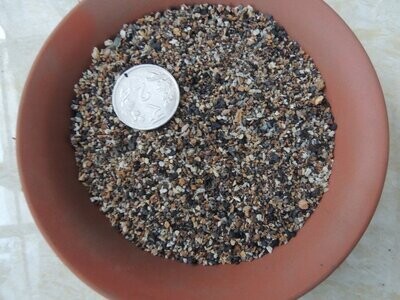
Cactus Seed Planting Mix
Cactus Seed Planting Mix
Sterile, Fine-Grain Media for Cactus & Succulent Seeds
SKU MNS005
₹74.85
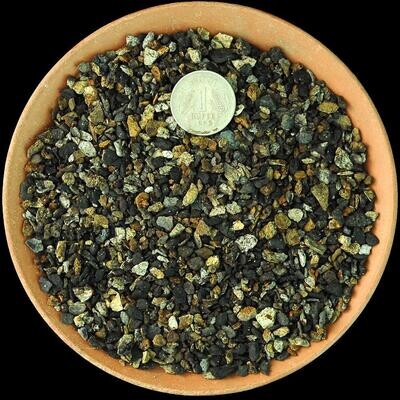
Cactus & Succulent Planting Mix COARSE (aka Cactus Soil Mix or Succulent Soil Mix)
Cactus & Succulent Planting Mix COARSE (aka Cactus Soil Mix or Succulent Soil Mix)
Washed, Free-Draining Mineral Mix for Cactus & Succulents
SKU MNS003
5.0
(1)
₹44.85
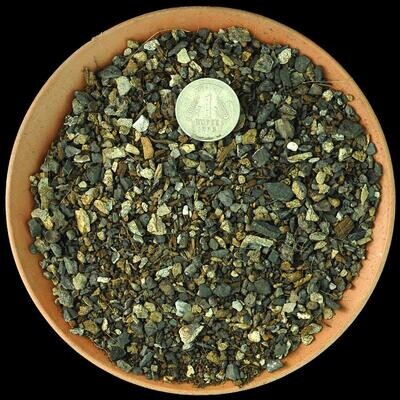
FORTIFIED Cactus & Succulent SOIL (COARSE)
FORTIFIED Cactus & Succulent SOIL (COARSE)
SKU MNS004
5.0
(12)
₹54.85
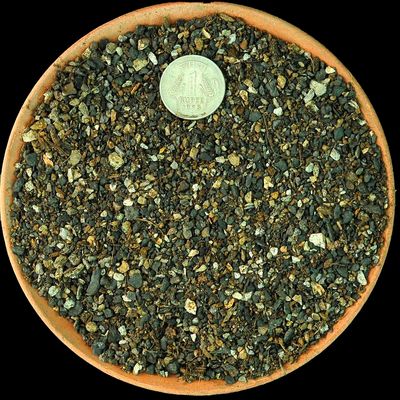
FORTIFIED Cactus & Succulent SOIL (FINE)
FORTIFIED Cactus & Succulent SOIL (FINE)
SKU MNS002
5.0
(4)
₹49.85
Display prices in:INR
