
Categories
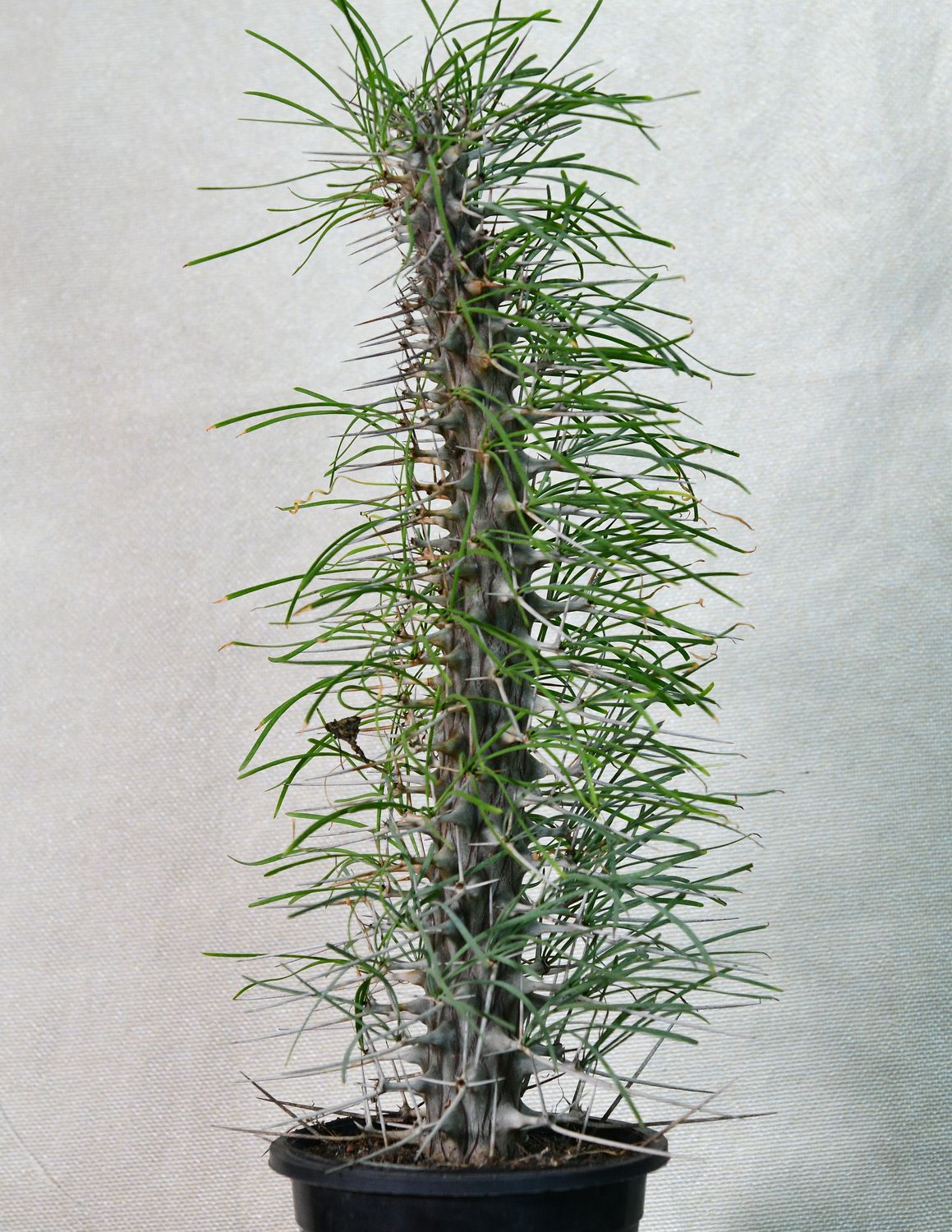
Didierea madagascariensis
SKU PA087
₹2 800.00
Deeply cut foliage with vibrant coral-red flower clusters
In stock: 1 available
1
Save this product for later
Customer reviews
Reviews only from verified customers
No reviews yet. You can buy this product and be the first to leave a review.
Didierea madagascariensis
Product Details
18 inches
Meet the Octopus Tree — one of Madagascar's strangest botanical creations. Grey-white spines in neat whorls, ribbon-like leaves that flush bright green in the growing season, and arms that sprawl like tentacles before rising skyward. It looks like a cactus, but it isn't one. It belongs to a small family found only on Madagascar. A true conversation piece for the serious collector.
Origin of Name
The genus Didierea was published by the French botanist Henri Ernest Baillon in 1880, in the Bulletin Mensuel de la Société Linnéenne de Paris. It honours the French naturalist and explorer Alfred Grandidier (1836–1921), who observed the plant near Tuléar (Toliara) in south-western Madagascar. Grandidier spent years exploring the island, and a great many Malagasy plants and animals carry his name.
The name has an unusual construction. The obvious honorific, Grandidiera, had already been given to another plant genus. Baillon therefore took the second half of the explorer's surname, "-didier", and Latinised it into Didierea.
The epithet madagascariensis means "of Madagascar". The plant is the type species of the genus. Its old synonym Didierea mirabilis ("wonderful") shows how remarkable it seemed to 19th-century botanists.
The Malagasy call it sohongy, sony or soribarika. Sony and sohongy come from the Tanosy dialect word songo, meaning a lock of hair or a rooster's comb. The name probably refers to the upswept, crest-like branches. In English it is known as the Octopus Tree.
Origin of Plant
Didierea madagascariensis is endemic to the spiny thickets of south-western Madagascar. This is one of the most unusual dry ecosystems on Earth. The plant grows on sandy soils and coastal dunes where annual rainfall is low and the dry season can last eight months or more. Around the Ifaty–Toliara region it forms a dramatic, forest-like landscape together with Alluaudia and baobabs.
Description
The Octopus Tree is a woody, semi-succulent shrub that eventually becomes a small tree.
- Size: In the wild it can reach up to 10 m. In cultivation it stays far smaller and grows slowly.
- Growth habit: Young plants often sprawl low along the ground, sending out tentacle-like arms, and later grow upright. This habit gives the plant its common name.
- Spines: Long, pale spines are arranged in neat whorls, usually four at a time, along the stems.
- Leaves: The leaves are narrow, lance-shaped and grass-like, and grow in small rosettes just above each spine cluster. They are deciduous and drop during dry or cool dormancy.
- Flowers: The species is dioecious, meaning male and female flowers grow on separate plants. The small flowers are pale yellowish-green.
- Convergent evolution: The plant is a textbook example of convergent evolution. It is not related to cacti, yet it developed the same succulent, spiny, water-storing strategy entirely independently.
Conservation Status
- IUCN Red List: Least Concern (assessed 2019). The species is widespread within its restricted range.
- CITES: Appendix II, as is the whole genus Didierea. International trade is regulated to protect wild populations.
- Threats: The spiny thicket habitat is under serious pressure from clearance, charcoal production and grazing.
- Our plants: They are nursery-propagated. Buying cultivated plants helps keep collecting pressure off wild stands.
Care
- Light: Give bright light to full sun. Young plants prefer light shade during the harshest midday heat, and mature plants can take full sun.
- Watering: Water regularly during the warm growing season when the plant is in leaf, letting the soil dry out between waterings. Keep it almost completely dry once the leaves drop for dormancy.
- Soil: Use a very free-draining mineral mix, such as pumice, coarse sand and grit, with a small amount of organic matter.
- Pot: Terracotta or other breathable pots are ideal. They must have generous drainage holes.
- Temperature: The plant is heat-loving and frost-tender. Keep it above about 10°C in winter, and keep it dry in cold weather to prevent rot.
- Feeding: Apply a diluted, low-nitrogen cactus fertiliser monthly during active growth. Do not feed during dormancy.
- Tip: Protect the plant from prolonged rain and waterlogging. Leaf drop in the cool season is normal and not a sign of distress.
A Story Worth Telling
When Baillon described Didierea in 1880, he wrote that the plant did not fit any family then known. He predicted it would become the type of an entirely new family. He was right. In 1896 botanists formally established the family Didiereaceae, a group found only on Madagascar.
The wild habitat is famous for its wildlife as well as its plants. In the spiny forests of the south, Verreaux's sifakas are known to leap between the heavily armed trunks of Didierea and Alluaudia without injury. Among the thorns, these lemurs bound upright on their hind legs, a sight regarded as one of Madagascar's great natural spectacles. Owning an Octopus Tree means owning a small piece of that extraordinary world.
Display prices in:INR
