
Categories
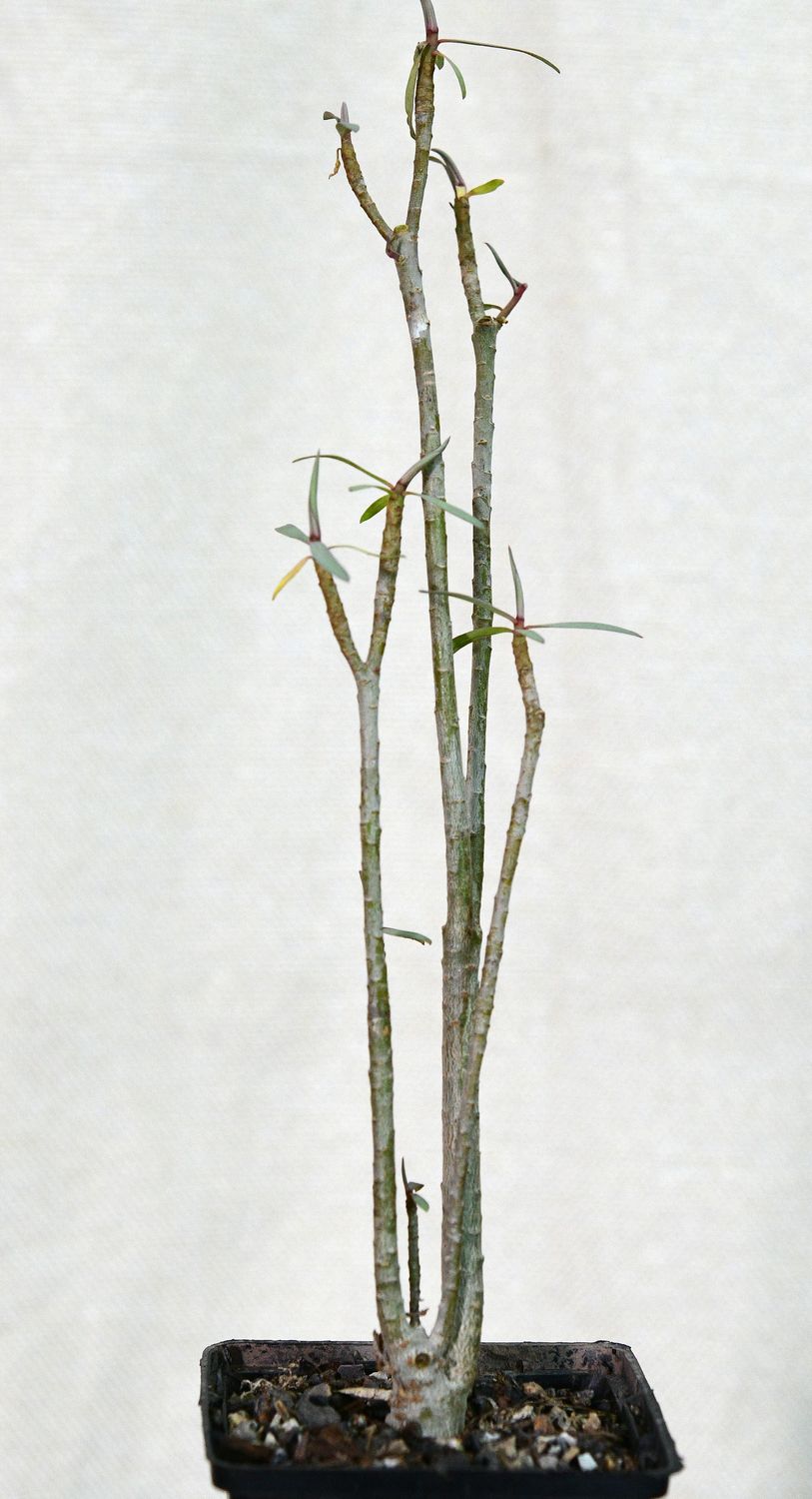
Euphorbia balsamefera
SKU EU177
₹3 300.00
Sold out
Sold out
Save this product for later
Customer reviews
Reviews only from verified customers
No reviews yet. You can buy this product and be the first to leave a review.
Euphorbia balsamefera
Product Details
A gnarled, grey-barked desert shrub crowned with whorls of slender, glaucous leaves — the "balsam-bearing" spurge of the Canary Islands and the Sahara's rocky edge, whose sweet, resinous latex once left its native islands as a chewing gum sold across mainland Spain under a brand nobody back home ever got to buy.
Origin of Name
The species epithet balsamifera is built from the Latin balsamum — "balsam," an aromatic, resinous plant exudate — and -fera, from ferre, "to bear" or "to carry." Together they give "balsam-bearing," a direct, descriptive nod to the plant's milky latex, which is notably less caustic and more aromatic than that of most of its Euphorbia relatives, and which has been tapped, chewed, and traded by the people of its native range for centuries.
It was formally described by William Aiton (1731–1793), the Scottish-born gardener who rose to become the first director of the Royal Botanic Gardens, Kew, a post he held from 1759 until his death. Aiton published the name in his landmark Hortus Kewensis (volume 2, page 137) in 1789. The species carries several vernacular names: "balsam spurge" in English, and tabaiba dulce ("sweet tabaiba") in the Canary Islands, where it's considered a vegetable symbol of Lanzarote.
Origin of Plant
An unusually wide native range for a succulent Euphorbia — from the Canary Islands across western Morocco and Western Sahara, through arid North Africa as far as Somalia, Saudi Arabia, and Oman. It grows on rocky ground and stabilized sandy dunes, often above 800 metres elevation, in dense communities with other succulents. In the Canary Islands, leaves were traditionally cooked as a green vegetable, and in Morocco the latex has been used in folk dentistry to numb acute tooth pain.
Description
A dichotomously branching, semi-succulent shrub or small tree, 2–5 m tall in habitat (more compact in cultivation). Grey to terracotta branches thicken and grow knotty with age, ringed with transverse leaf scars. Leaves cluster in dense whorls at the tips — linear-lanceolate to ovate, green to glaucous, up to 8 cm long. Small yellowish-green cyathia appear in terminal cymes winter through summer, followed by three-lobed capsules ripening green to pinkish-red. The milky latex is mildly irritating rather than sharply caustic.
Conservation Status
Not separately assessed on the IUCN Red List; widespread and locally abundant across its broad range. Falls under the genus-wide CITES Appendix II listing for succulent Euphorbias — nursery-propagated stock like this one sits outside wild-collection concerns.
Care
Light: As much bright, direct sun as possible. Watering: Water when the top inch of soil dries through spring/summer; cut back sharply in winter. Soil: Gritty, well-draining succulent mix. Temperature: Hardy to about -1°C (30°F) briefly, happiest above 10°C (50°F). General tips: Feed sparingly in the growing season; handle cuttings with gloves, and let cut ends callus before rooting.
A Story Worth Telling
In 1945, Gran Canarian entrepreneur Augusto Hernández Rodríguez patented "Chicles Tabay" — Spain's first registered-trademark chewing gum, made from tapped tabaiba dulce latex. Since the islands lacked manufacturing capacity, the raw latex was shipped to Barcelona for processing and sold across the Spanish mainland from 1946, marketed with cyclist trading cards. It quietly vanished by the 1950s — and in one of botany's small ironies, this thoroughly Canarian gum was never actually sold in the Canary Islands.
You May Also Like


Cactus & Succulent Planting Mix FINE (aka Cactus Soil Mix or Succulent Soil Mix)
Cactus & Succulent Planting Mix FINE (aka Cactus Soil Mix or Succulent Soil Mix)
Fine-Grain Potting Mix for Cactus & Succulent Roots
SKU MNS001
5.0
(3)
₹39.85
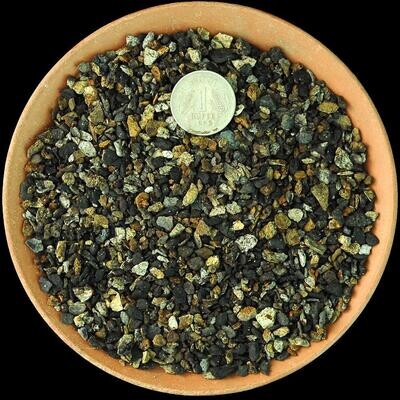
Cactus & Succulent Planting Mix COARSE (aka Cactus Soil Mix or Succulent Soil Mix)
Cactus & Succulent Planting Mix COARSE (aka Cactus Soil Mix or Succulent Soil Mix)
Washed, Free-Draining Mineral Mix for Cactus & Succulents
SKU MNS003
5.0
(1)
₹44.85
New


Monsoon Guardian Kit (5 in 1)
Monsoon Guardian Kit (5 in 1)
Complete 5-in-1 biological protection kit for cacti & succulents
SKU MNS024
₹850.00

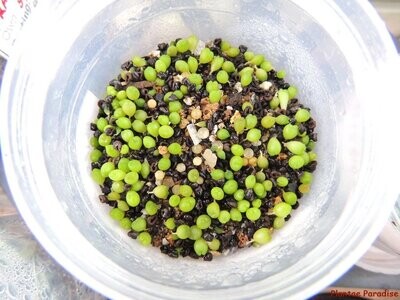
Cactus Seed Planting Mix
Cactus Seed Planting Mix
Sterile, Fine-Grain Media for Cactus & Succulent Seeds
SKU MNS005
₹74.85
Display prices in:INR
