
Categories
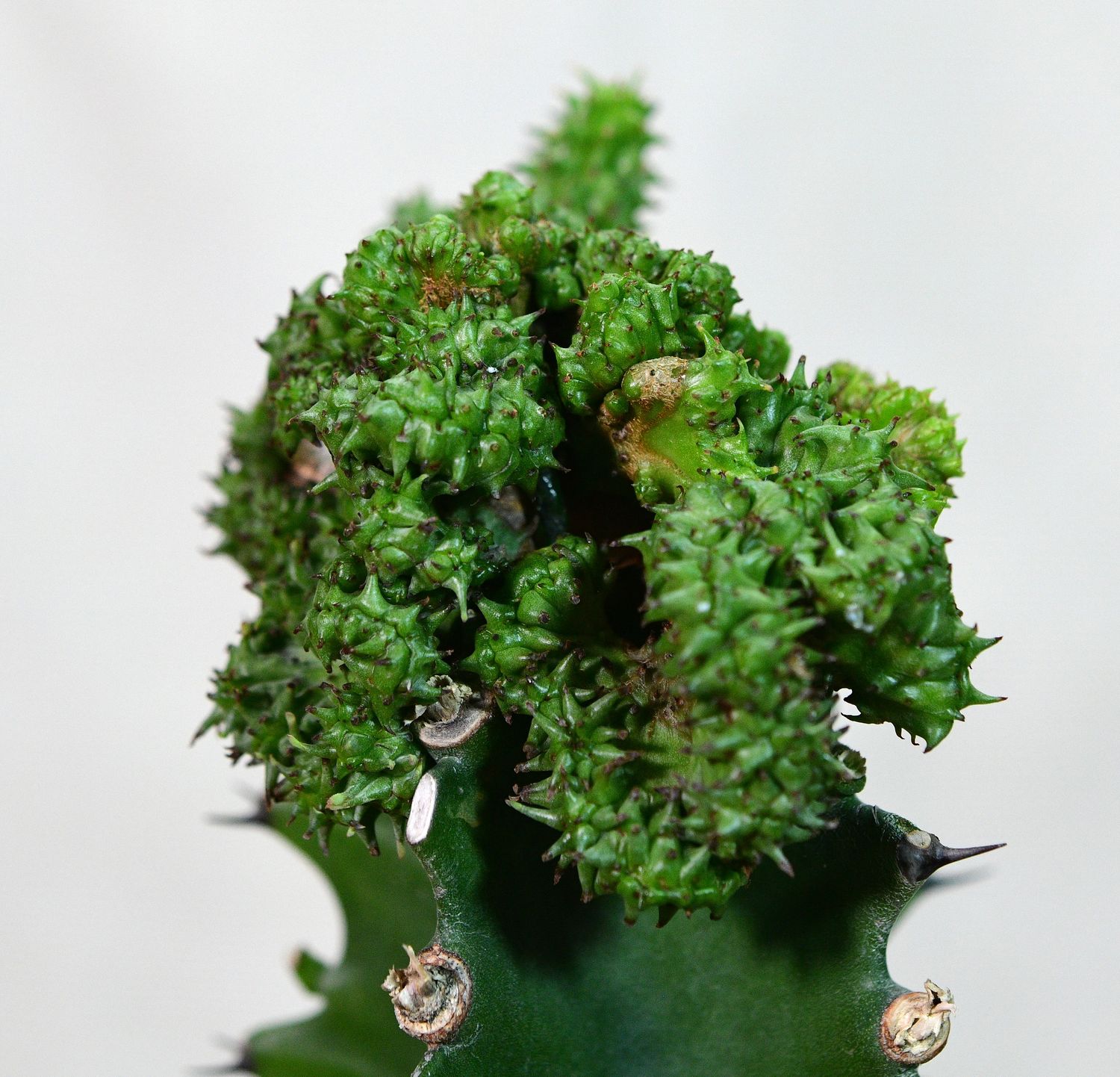
Euphorbia horrida crest
SKU EU049
₹700.00
In stock: 1 available
1
Save this product for later
Customer reviews
Reviews only from verified customers
No reviews yet. You can buy this product and be the first to leave a review.
Euphorbia horrida crest
Product Details
Euphorbia horrida f. cristata (Crested African Milk Barrel)
A dense, tangled green mound of tubercled, spine-tipped tissue folding endlessly back on itself — this crested form of the African milk barrel abandons the tidy, ribbed columns of its normal self entirely, growing instead as a strange, undulating crown that looks more like coral or a brain than a cactus-like succulent.
Origin of Name
The species epithet horrida is straightforward Latin — from horrere, "to bristle" or "to stand on end," the same root that gives English words like "horrid" and "horror." Applied to a plant, it's a purely descriptive nod to the dense clusters of rigid, formidable spines armouring the stems — nothing sinister intended, just an accurate label for a plant that looks genuinely bristling with defence. It was formally described in 1860 by the Swiss botanist Pierre Edmond Boissier (1810–1885) in his monograph Centuria Euphorbiarum — literally "a hundred Euphorbias" — a landmark work in which Boissier, one of the most prolific plant taxonomists of the 19th century, catalogued a hundred species new to science in the genus, later expanding on many of them with detailed illustrations in his 1866 Icones Euphorbiarum. Modern taxonomic revision has since folded Euphorbia horrida into the earlier-named Euphorbia polygona (Haworth, 1803) as a synonym, though "Euphorbia horrida" remains, by a wide margin, the name still used in the succulent trade and by most growers.
The plant offered here carries an additional tag: f. cristata ("crested form"), or simply "crested." This isn't a botanical variety or a bred cultivar at all — it describes a naturally occurring growth abnormality called fasciation, in which the plant's single growing point stops growing as a point and instead elongates into a band or ridge, producing the folded, fan-like, brain-like mass seen here instead of the species' usual straight, ribbed column. Crested succulents of all kinds are prized by collectors precisely because this mutation is rare, unpredictable, and never quite the same twice.
Origin of Plant
Euphorbia horrida is endemic to South Africa's arid interior, native to the Great Karoo and the mountainous country of the Eastern and Western Cape — recorded historically around Willowmore and the Wittepoort mountains, and across the wider polygona/horrida complex's range through the Kouga, Baviaanskloof, Groot Winterhoek, and Suurberg mountains toward Makhanda. It grows scattered among rocks and low scrub on sun-baked, gravelly, and rocky slopes that stay dry for most of the year — classic semi-desert Karoo terrain, where its thick, water-storing stems and dense spine armour offer real protection against both drought and browsing animals. Boissier's 1860 description came during a period of intense 19th-century European botanical interest in the extraordinary succulent flora of the Cape, much of it driven by plant material and dried specimens sent back from South African collectors and expeditions to herbaria in Europe.
The crested specimen offered here has no wild habitat of its own in this form — cristate growth is occasionally found on wild plants but is far more often selected, encouraged, and stabilized in cultivation, where growers propagate a crest that appears spontaneously by grafting a piece onto sturdy rootstock or rooting it directly, since the mutation isn't reliably passed on through seed.
Description
In its ordinary form, Euphorbia horrida grows as an erect, clump-forming succulent up to a metre or more tall, its thick, cylindrical stems ridged with 10 to 20 wavy, wing-like ribs in a distinctive blue-grey to grey-green, armed along each rib with stiff, radiating spines that are, in fact, the dried, hardened remains of old flower stalks rather than true spines.
This crested specimen abandons that architecture entirely. Instead of a single growing tip pushing straight upward, the growth point has fasciated into a ridge, folding and refolding on itself as it grows to produce a dense, irregular, cauliflower- or brain-like mound of small, tightly packed, tuberculate green segments, each one still tipped with the same dark, bristling spine clusters typical of the species — visible here as the fine reddish-brown points scattered across every lobe of the crest. A few normal, upright, more conventionally ribbed shoots are pushing up from the crest's edges in this specimen, a common and expected occurrence, since crested growth constantly "wants" to revert to the plant's normal habit given the chance. Left entirely to itself, a crest like this will keep folding outward and expanding for years, slowly building into a genuinely sculptural, one-of-a-kind mounded form no two examples ever quite replicate. Like the straight species, it produces small, inconspicuous greenish-yellow cyathia (the specialized flower clusters typical of Euphorbia) in summer, though flowering is a minor feature next to the crest's dramatic form.
Conservation Status
Euphorbia horrida (now generally treated as part of Euphorbia polygona) has not been separately assessed on the IUCN Red List, though it is naturally restricted to a fairly narrow band of Karoo and Cape mountain habitat and is considered locally uncommon by South African botanists. Virtually all succulent Euphorbia species — this one included — are listed under CITES Appendix II, meaning international trade in wild-collected material is tightly regulated. As with all cristate forms, this specimen exists purely as a cultivated, nursery-propagated plant grown from grafted or rooted crest material, never wild-collected, making it an entirely sustainable and legal way to own one of these striking mutations.
Care
Light: Bright light is important for compact, healthy growth, ideally several hours of direct or strong filtered sun daily; ease a crested specimen into full sun gradually, since the tightly folded surface can scorch more readily than a normal stem's smoother profile.
Watering: Unusually for a succulent, Euphorbia horrida doesn't tolerate prolonged drought well and appreciates more regular watering than many of its stablemates — water when the top couple of centimetres of soil have dried out, roughly weekly through the growing season, then cut back significantly in winter. Always use a fast-draining mix so water never sits around the base.
Soil: A gritty, mineral-rich succulent or cactus mix with excellent drainage; a container with a generous drainage hole is essential.
Temperature: A warm grower that dislikes cold and damp together — keep it above roughly 10°C (50°F) and protect it from any frost.
Handling & propagation: The milky white sap is toxic and can irritate skin and eyes badly, so always wear gloves when handling or taking cuttings, and keep cut ends away from the face. To keep the crest looking its best, prune away any normal, non-crested shoots that appear at its base or edges as soon as you notice them — otherwise the more vigorous ordinary growth will gradually take over and the crest will be crowded out.
An Interesting Note
Euphorbia horrida is one of the classic textbook examples of convergent evolution in the plant world: despite belonging to the spurge family, an entirely different lineage from true cacti, it independently evolved the same thickened, ribbed, spine-studded, water-storing body plan as its New World cactus look-alikes — a case of two unrelated plant families arriving at strikingly similar solutions to the same arid-climate problem, separated by an ocean and millions of years of evolution. Crested forms like this one add an extra layer of individuality on top of that convergence: because fasciation is a chance developmental accident rather than an inherited trait, every single crested Euphorbia in cultivation is, in effect, a unique clone descended from one particular plant that happened to mutate this way — which is exactly why dramatic, well-formed crests like this one are so keenly sought after by collectors, each one a genuine one-off.
You May Also Like

FORTIFIED Cactus & Succulent SOIL (COARSE)
FORTIFIED Cactus & Succulent SOIL (COARSE)
SKU MNS004
5.0
(11)
₹54.85
New
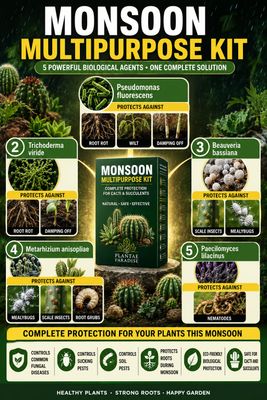
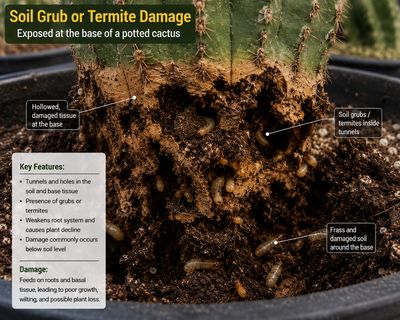
Monsoon Guardian Kit (5 in 1)
Monsoon Guardian Kit (5 in 1)
Complete 5-in-1 biological protection kit for cacti & succulents
SKU MNS024
₹850.00


Cactus Seed Planting Mix
Cactus Seed Planting Mix
Sterile, Fine-Grain Media for Cactus & Succulent Seeds
SKU MNS005
₹74.85
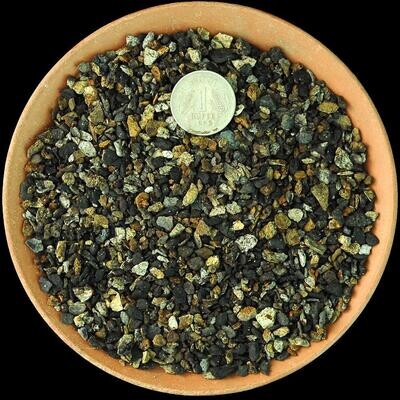
Cactus & Succulent Planting Mix COARSE (aka Cactus Soil Mix or Succulent Soil Mix)
Cactus & Succulent Planting Mix COARSE (aka Cactus Soil Mix or Succulent Soil Mix)
Washed, Free-Draining Mineral Mix for Cactus & Succulents
SKU MNS003
5.0
(1)
₹44.85
Display prices in:INR
