
Categories
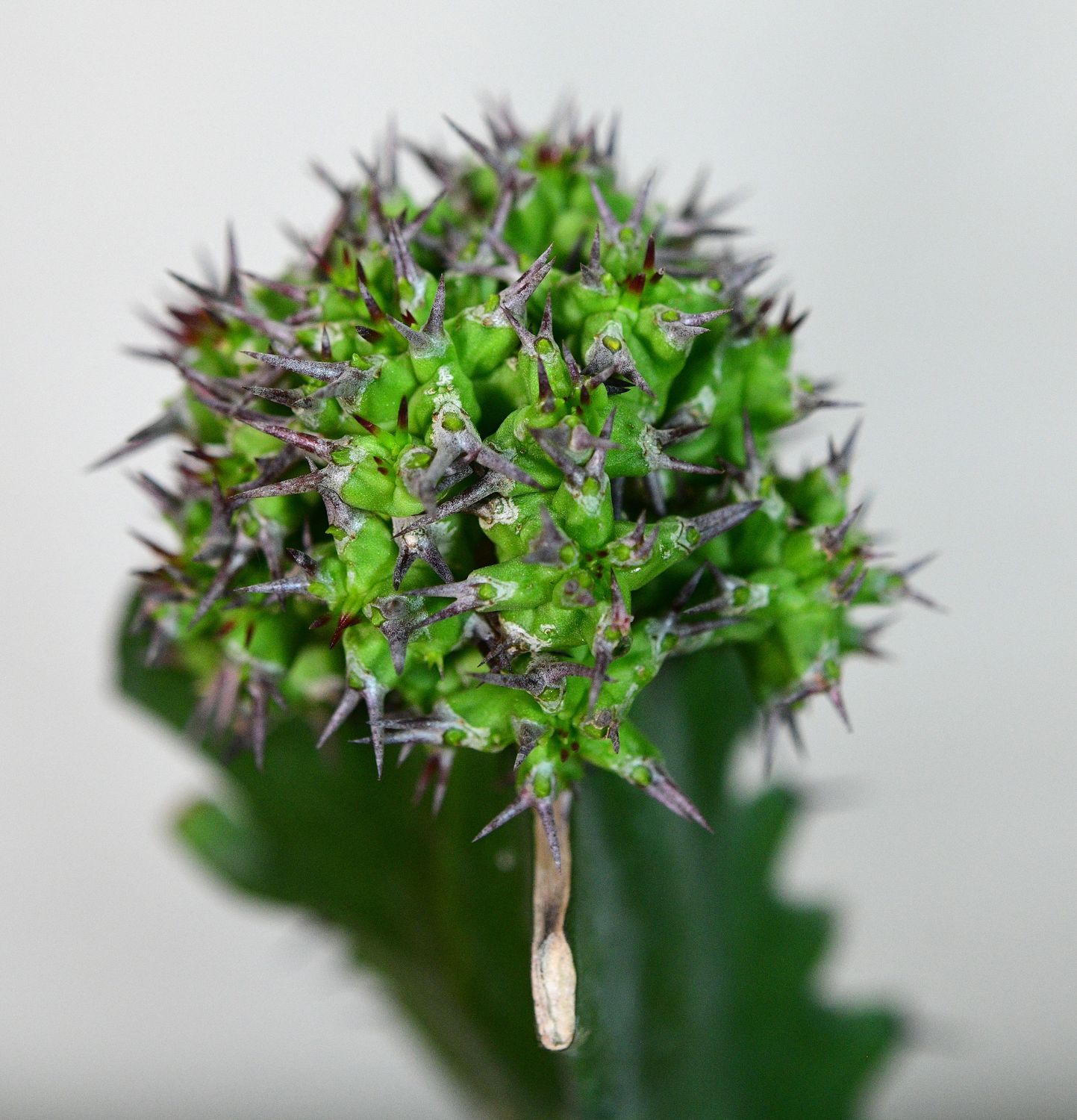
Euphorbia mitriformis
SKU EU133
₹850.00
In stock: 1 available
1
Save this product for later
Customer reviews
Reviews only from verified customers
No reviews yet. You can buy this product and be the first to leave a review.
Euphorbia mitriformis
Product Details
Euphorbia mitriformis
A tight, bristling dome of star-angled green tubercles, each one armed with a pair of stout spines that darken from pale grey to a rich purplish-black with age — a slow-growing dwarf Euphorbia from one of the most remote mountain ranges in the Horn of Africa, prized by collectors for its dense, sculptural, almost sea-urchin-like head.
Origin of Name
The species epithet mitriformis combines the Latin mitra — a bishop's tall, pointed ceremonial headdress — with forma, "shape" or "form," giving "mitre-shaped." Seen from above, each individual stem is deeply five-angled, its ridges radiating outward from the centre into a distinct star, and as new growth pushes upward at the growing tip it takes on a peaked, domed profile reminiscent of that same ecclesiastical headpiece — the same descriptive logic behind the unrelated but similarly named Aloe mitriformis, a Cape succulent whose folding winter rosette earned it the identical Latin tag for a different reason entirely.
The species was formally described in 1976 by Peter René Oscar Bally (1895–1980) and Susan Carter (later Susan Carter Holmes, b. 1933), publishing it in the Cactus and Succulent Journal of Los Angeles. Bally was a Swiss-born botanist who spent most of his career in Nairobi, first as government botanist at the Coryndon Museum from 1938 and later through decades of fieldwork across the semi-desert Horn of Africa, describing dozens of new succulent species across genera including Aloe, Caralluma, Sansevieria, and above all Euphorbia. Carter, working from the Royal Botanic Gardens, Kew, became one of the 20th century's foremost authorities on East African succulent spurges, eventually cataloguing more than 200 species in the family Euphorbiaceae and later authoring the official CITES Checklist of Succulent Euphorbia Taxa (1997) — the reference document customs and conservation authorities still use worldwide to identify regulated Euphorbia species in trade. Together, Bally and Carter described a long run of new spiny Somali and East African Euphorbias through the 1970s and 80s, working from plant material collected on expeditions into some of the region's most difficult and least-botanized terrain — Euphorbia mitriformis is one of that partnership's finds.
Origin of Plant
Euphorbia mitriformis is endemic to a single, narrow range in northeastern Somalia — the Al Madow mountains of the Sanaag region — where it grows wedged into rocky, limestone slopes at elevations between roughly 1,200 and 1,600 metres. This is genuinely remote country: dry, mountainous, and among the least-explored botanical territory on the African continent, both for its ruggedness and for decades of regional instability that have made sustained fieldwork there rare. Species like this one entered science largely through the efforts of dedicated specialists such as Bally and Carter, whose expeditions into the Somali interior in the 1970s turned up a steady stream of previously unknown spiny Euphorbias found nowhere else on Earth — this being one of them, restricted to its single limestone mountain range and found in no other country.
Description
This is a slow-growing, clump-forming dwarf succulent, its narrow, deeply five-angled stems reaching only about 1.5 cm in diameter but, over time, up to a metre tall, branching and clustering into dense, rounded, mound-like shrubs. Each of the stem's five ridges bears short, thick, closely set spine pairs roughly 2.5 cm long, coloured a pale greyish-white when fresh and darkening with age and season to a deep reddish or purplish-black — exactly the striking two-tone bristling seen on a healthy growing head, where fresh green tubercles studded with near-black spine tips give the plant a dense, urchin-like texture. Small, inconspicuous red flowers only 2–3 mm across appear in loose cyme clusters at the stem tips, followed by tiny three-parted seed capsules holding seeds barely a millimetre long — the dried, spent flower stalk often persisting as a slender brown spike long after the bloom itself has finished, as seen hanging below the spiny head in a mature specimen. Some forms of the species grow with shorter, tightly packed stems for an especially compact mound, while others produce longer, more openly spaced growth — a natural variability collectors watch for when selecting plants.
Conservation Status
Euphorbia mitriformis has not been separately assessed on the IUCN Red List, but its extremely narrow endemic range — a single mountain system in politically unstable, poorly surveyed northeastern Somalia — makes it inherently vulnerable to any disturbance, even though no acute threat has been formally documented. Like virtually all succulent Euphorbia species, it is listed under CITES Appendix II, meaning international trade in wild-collected material is tightly controlled — a protection framework that Susan Carter herself, one of this species' own describers, helped codify in her 1997 CITES checklist. A nursery-propagated plant such as this one is an easy, responsible way to grow a genuinely rare regional endemic without any pressure on its small wild population.
Care
Light: Give it as much bright light as possible — abundant sun is what keeps the stems tight, compact, and densely spined rather than stretched and sparse.
Watering: Water regularly through the growing season, allowing the soil to dry out between waterings, then cut back sharply in winter to avoid the root and stem rot this species is prone to when kept wet and cool at the same time.
Soil: A gritty, mineral-rich, fast-draining succulent or cactus mix, echoing the rocky limestone slopes of its native habitat.
Temperature: A warm grower with no frost tolerance at all; keep it above about 10°C (50°F) year-round.
General tips: Feed sparingly — a dilute dose of fertilizer once a year during the growing season is generally plenty. Handle with care when repotting or taking cuttings, as the milky latex sap typical of Euphorbias is irritating to skin and eyes; let any cut surface callus over for several days before rooting it in dry, gritty soil.
An Interesting Note
Euphorbia mitriformis is a reminder of just how much of the world's succulent diversity remains tucked away in places few outsiders ever reach. Its entire known wild population exists on one limestone mountain range in a corner of Somalia that has seen only sporadic botanical fieldwork over the past half-century, and it owes its very existence in science to a partnership between a self-taught Swiss field botanist working out of a Nairobi museum and a meticulous Kew taxonomist who between them pieced together the succulent flora of one of Africa's most under-documented regions, one expedition at a time.
You May Also Like
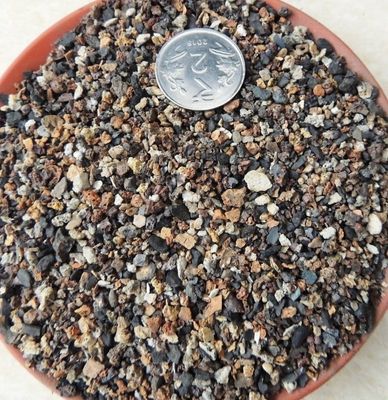
Cactus & Succulent Planting Mix FINE (aka Cactus Soil Mix or Succulent Soil Mix)
Cactus & Succulent Planting Mix FINE (aka Cactus Soil Mix or Succulent Soil Mix)
Fine-Grain Potting Mix for Cactus & Succulent Roots
SKU MNS001
5.0
(3)
₹39.85
New


Monsoon Guardian Kit (5 in 1)
Monsoon Guardian Kit (5 in 1)
Complete 5-in-1 biological protection kit for cacti & succulents
SKU MNS024
₹850.00

FORTIFIED Cactus & Succulent SOIL (COARSE)
FORTIFIED Cactus & Succulent SOIL (COARSE)
SKU MNS004
5.0
(11)
₹54.85

Cactus & Succulent Planting Mix COARSE (aka Cactus Soil Mix or Succulent Soil Mix)
Cactus & Succulent Planting Mix COARSE (aka Cactus Soil Mix or Succulent Soil Mix)
Washed, Free-Draining Mineral Mix for Cactus & Succulents
SKU MNS003
5.0
(1)
₹44.85
Display prices in:INR
