
Categories
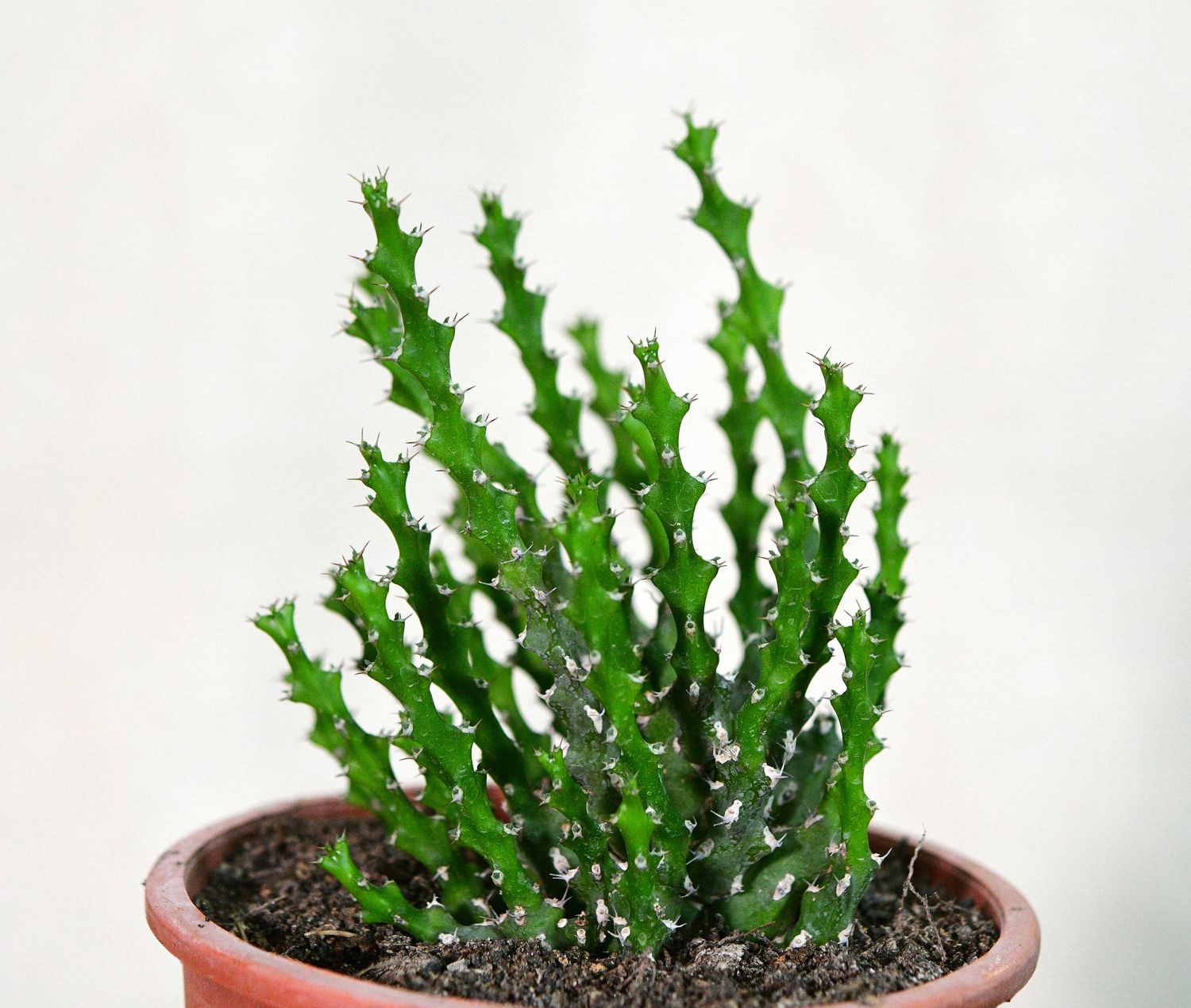
Euphorbia ramulosa
SKU EU130
₹3 800.00
Upright ribbed euphorbia with desert elegance
In stock: 2 available
1
Save this product for later
Customer reviews
Reviews only from verified customers
No reviews yet. You can buy this product and be the first to leave a review.
Euphorbia ramulosa
Product Details
Euphorbia ramulosa
A dense, twiggy little shrublet armed all over with fine paired spines — a miniature thicket-in-a-pot that clings to bare granite domes in northern Mozambique, described by an English-born electrical engineer who gave up his day job to become, by his own account, "probably Rhodesia's only unpaid civil servant."
Origin of Name
The species epithet ramulosa comes from the Latin ramulus, a diminutive of ramus ("branch"), combined with the adjectival suffix -osus ("full of" or "abounding in"). Together they mean "full of little branches" — a plainly descriptive name for a plant whose defining trait is its dense, twiggy, many-branched habit, so different from the single fat stem or paddle-shaped growth of many of its better-known succulent cousins.
It was formally described by Leslie Charles "Larry" Leach (1909–1996), an Englishman who arrived in Salisbury, Rhodesia (now Harare, Zimbabwe) in 1938 to work as an electrical engineer. In 1956 he set aside his career to pursue succulent taxonomy full-time, entirely self-financed, and went on to become one of the twentieth century's most prolific describers of southern African Euphorbia, Stapelieae, and Aloe species — despite having no formal botanical training. From 1972 to 1981 he served as Honorary Botanist at Rhodesia's National Herbarium, a role he wryly summed up as making him the country's only unpaid civil servant. His fieldwork took him deep into Mozambique, Angola, South West Africa (Namibia), and across southern Africa more broadly, and it was from one of these Mozambican expeditions that Euphorbia ramulosa was collected and named.
Origin of Plant
Euphorbia ramulosa is native to northern Mozambique, where it occupies a strikingly specific niche: the bare, sun-blasted surfaces of granite inselbergs — the smooth domes and slabs of exposed bedrock that rise abruptly from the surrounding woodland across much of central and southern Africa. There it roots in shallow soil pockets and rock crevices, and along the margins where the granite gives way to open woodland, conditions that offer almost no buffer against sun, heat, or drought. Granite inselbergs like these are known among botanists as refuges for narrowly distributed, highly specialized flora, and Larry Leach's extensive collecting on exactly this kind of terrain across Mozambique and Rhodesia in the 1960s–80s turned up dozens of new succulent species that exist nowhere else — E. ramulosa among them.
Description
Euphorbia ramulosa is a low, densely branched succulent shrublet reaching only about 40 cm (16 in) in height at maturity — modest in stature but architecturally busy, built from a tangle of rigid, four-angled branches up to about 16 cm (6.4 in) long and 2 cm (0.8 in) thick. The branch surfaces are set with prominent tubercles spaced roughly 1.3 cm (0.5 in) apart, each bearing a spine shield from which paired, spreading spines around 7–8 mm (0.3 in) long project outward — giving the whole plant a fine, bristling texture quite unlike the smooth ribs of a globular Euphorbia. In autumn it produces small greenish-yellow cyathia (the specialized flower clusters typical of the genus), followed by seed capsules containing greyish-brown seeds. The overall effect, in a pot, is closer to a miniature spiny thicket than a conventional "cactus-like" succulent — a plant that rewards a closer look at its dense branching structure rather than a single dramatic silhouette.
Conservation Status
Euphorbia ramulosa has not been separately assessed on the IUCN Red List. Its native range is narrow and tied to a specific habitat type — exposed granite inselbergs in northern Mozambique — the kind of restricted, specialized distribution that tends to make a species intrinsically vulnerable to habitat disturbance, even without a formal Red List rating. As with virtually all succulent Euphorbia species, it falls under the genus-wide CITES Appendix II listing, meaning international trade in wild-collected material is regulated; artificially propagated nursery stock, such as the plant offered here, sits outside the concerns attached to wild collection.
Care
Light: Give it as much bright light as possible. In its native habitat this plant grows fully exposed on bare rock with no natural shade, so it wants a sunny, bright spot indoors or a position with strong light outdoors; acclimate gradually if moving it from lower light.
Watering: Somewhat unusually for a succulent, E. ramulosa does best with regular watering through summer — roughly weekly — rather than the long dry spells many other Euphorbias tolerate. It doesn't like sitting in soggy soil, but it also doesn't appreciate extended drought, so aim for a middle ground: water when the topsoil has just dried, and reduce frequency in winter.
Soil: A gritty, fast-draining succulent or cactus mix is essential, mirroring the thin, rocky soil pockets of its granite habitat.
Temperature: Best suited to USDA zones 10a–11b, roughly -1°C to 10°C (30°F to 50°F) as a minimum tolerance; protect from frost and keep it warm and dry in winter.
General tips: Propagate from cuttings, dipping the cut end in rooting hormone and allowing it to callus before setting it into dry, gritty soil. If grown in a container, feed monthly during the growing season with a half-strength balanced fertiliser. As with all Euphorbias, the milky latex is irritating to skin and eyes, so handle cuttings with gloves.
A Story Worth Telling
Larry Leach never earned a botany degree. He spent his first two decades in Rhodesia as an electrical engineer, and it wasn't until 1956, already in his late forties, that he walked away from that career to chase succulent plants across some of the most inhospitable terrain in southern Africa — entirely on his own dime. Over the following four decades he became one of the great field botanists of the region, at one point holding the title of Honorary Botanist at Rhodesia's National Herbarium, a post that paid him nothing and which he joked made him "probably Rhodesia's only unpaid civil servant." His preferred hunting grounds were exactly the kind of terrain E. ramulosa calls home: the bald granite inselbergs scattered across Mozambique and Rhodesia, domes of bare rock that rise out of the woodland like stone islands, punishing to reach and search but disproportionately rich in plants found nowhere else on Earth. It was on one such expedition that Leach turned up this small, densely spined shrublet clinging to a crack in the granite, and gave it a name as unadorned and literal as the man himself: simply, "the branchy one."
You May Also Like
New
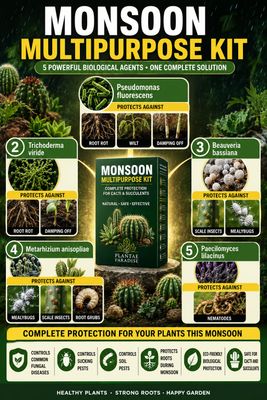
Monsoon Guardian Kit (5 in 1)
Monsoon Guardian Kit (5 in 1)
Complete 5-in-1 biological protection kit for cacti & succulents
SKU MNS024
₹850.00

Cactus & Succulent Planting Mix COARSE (aka Cactus Soil Mix or Succulent Soil Mix)
Cactus & Succulent Planting Mix COARSE (aka Cactus Soil Mix or Succulent Soil Mix)
Washed, Free-Draining Mineral Mix for Cactus & Succulents
SKU MNS003
5.0
(1)
₹44.85


Cactus Seed Planting Mix
Cactus Seed Planting Mix
Sterile, Fine-Grain Media for Cactus & Succulent Seeds
SKU MNS005
₹74.85
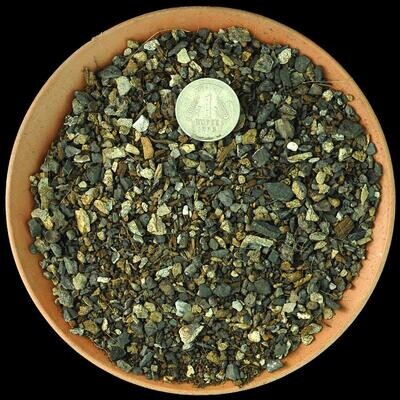
FORTIFIED Cactus & Succulent SOIL (COARSE)
FORTIFIED Cactus & Succulent SOIL (COARSE)
SKU MNS004
5.0
(11)
₹54.85
Display prices in:INR
