
Categories
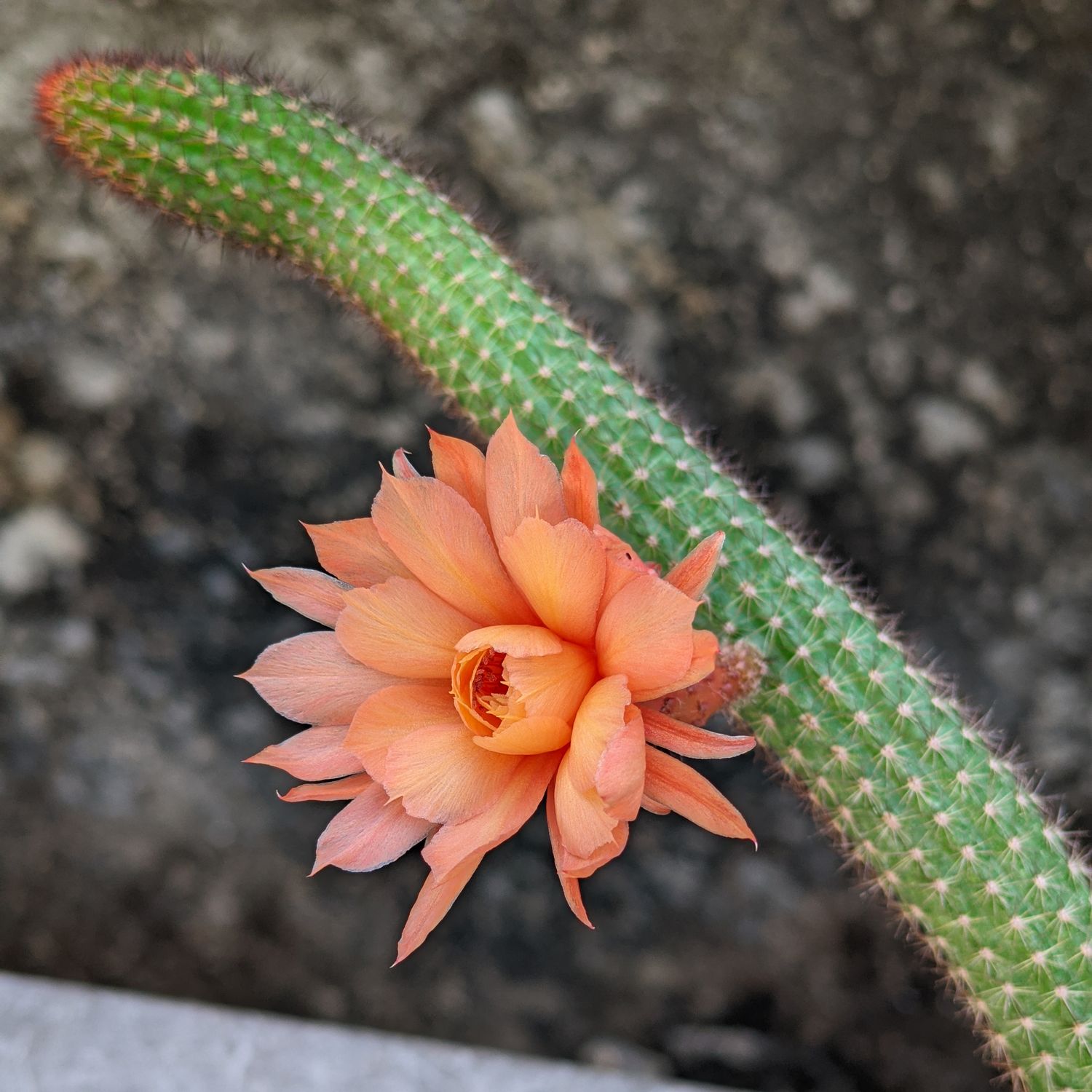
Hildewintera Humkes röschen
SKU HW028
₹650.00
In stock: 1 available
1
Save this product for later
Customer reviews
Reviews only from verified customers
No reviews yet. You can buy this product and be the first to leave a review.
Hildewintera Humkes röschen
Product Details
Hildewintera 'Humkes Röschen'
Some cacti announce themselves with sheer size; this one does it with abundance. A slender, trailing stem cloaked in fox-red spines that darken with age gives way, again and again through the growing season, to apricot-orange blooms — not one grand annual flush, but a plant that seems determined to flower whenever it possibly can.
1. Origin of Name
The genus name Hildewintera has a small family story behind it. It was coined in 1966 by the German botanist Friedrich Ritter, a tireless collector and describer of South American cacti, as a replacement for his own earlier name Winteria (1962) — both honouring his sister, Hildegarda "Hilde" Winter (1893–1975), who distributed the seeds he gathered on his expeditions. In the strict sense, Hildewintera was never validly published under the botanical code, and the plant's correct scientific placement today sits within Cleistocactus winteri — itself named for the same Hilde Winter. Even so, Hildewintera endures as the name collectors and nurseries actually use, and we honour that living tradition here alongside the technically correct synonym.
The cultivar name 'Humkes Röschen' translates from German as "Humke's little rose" — Röschen being the diminutive of Rose, a fittingly affectionate name for a plant so generous with its blooms. It arose from within the close-knit German Hildewintera-hybridising community (informally known by the shorthand "HWH"), where breeders trade pollen and seedlings among themselves and name their favourite results after each other. Documentation of individual cultivar histories in this hobbyist world is often sparse and kept in forum threads rather than formal registries, and we'd rather say so plainly than invent a fuller pedigree than what's actually recorded: the breeder "Humke" is credited by name in circulation, but a documented biography isn't publicly available. The cross itself pairs Hildewintera aureispina (syn. Cleistocactus winteri) with Cleistocactus colademononis — the "monkey's tail cactus," its epithet a Latinisation of the Spanish cola de mono, describing its shaggy, dangling stems.
2. Origin of Plant
Both parents in this hybrid's ancestry come from high, dry corners of the Andes. Hildewintera aureispina is endemic to Bolivia's Santa Cruz department, where it clings to rocky cliffs at around 1,400–1,500 metres elevation, its golden-spined stems hanging free from crevices in the rock face. Cleistocactus colademononis hails from similarly precipitous habitat in Peru, sharing the same cliff-dwelling, pendent growth habit that gives both species their trailing form.
'Humkes Röschen' itself has no wild habitat at all — it exists purely as a product of deliberate cultivation, born in a hobbyist's greenhouse rather than an Andean cliffside, carrying forward its parents' adaptations without any of their original geography.
3. Description
A slender, cylindrical, trailing stem — ideally suited to a hanging pot, where it can cascade rather than climb — densely set with fine spines that emerge a vivid fox-red on new growth before darkening to near-black with age, giving mature stems a richly textured, almost tortoiseshell appearance. Against this backdrop, the flowers are the real event: large, multi-petaled, and a warm apricot-orange fading toward soft pink at the petal tips, opening in a funnel shape and lasting for several days before fading. Rather than a single seasonal bloom, this cultivar is known for flowering repeatedly and generously across the growing season, with mature plants capable of producing dozens of blooms in a single year.
4. Conservation Status
As a member of the Cactaceae, this plant's lineage falls under CITES Appendix II, which regulates international trade in cacti generally through export permitting rather than prohibiting it outright. Worth noting separately: one of this hybrid's wild parents, Cleistocactus winteri, has been assessed as Endangered on the IUCN Red List, its restricted Bolivian cliff habitat leaving it vulnerable — a useful reminder that a plant's trade status and its wild conservation status are two different measures, and don't always tell the same story. This particular hybrid, however, is entirely nursery-propagated and exists only in cultivation, so it carries none of the wild-collection concerns attached to its parent species.
5. Care
- Light: Bright light with some direct morning or late-afternoon sun; protect from the harshest midday intensity, which can scorch the stems
- Watering: Water regularly through spring and summer, allowing the top of the soil to dry between waterings; reduce significantly in winter
- Soil: A fast-draining cactus or succulent mix; good drainage matters more than richness here
- Pot: A hanging pot or elevated planter suits its trailing habit best, letting the stems cascade naturally; terracotta helps prevent excess moisture retention
- Temperature: Keep above roughly 10°C (50°F) through winter; this is not a frost-hardy plant
- Feeding: A diluted, balanced cactus fertiliser during the active growing season supports strong flowering; withhold feed in winter dormancy
A Story Worth Telling
There's something quietly touching in a genus name built entirely out of family loyalty — Friedrich Ritter combing remote Bolivian cliffsides for new cacti, and his sister Hilde back home doing the equally unglamorous work of sorting, cataloguing, and distributing the seeds he sent her, patient labour without which none of his discoveries would ever have reached a grower's windowsill. That partnership, brother in the field and sister at the desk, is stitched permanently into the plant's name, however many times taxonomists have since tried to fold it back into Cleistocactus.
'Humkes Röschen' continues that same spirit of quiet, collaborative devotion, just a few generations later and an ocean of species away — an amateur breeder's careful cross, passed hand to hand through cutting exchanges and forum threads, prized less for taxonomic novelty than for the simple, generous fact that it flowers and flowers and flowers.
You May Also Like

FORTIFIED Cactus & Succulent SOIL (COARSE)
FORTIFIED Cactus & Succulent SOIL (COARSE)
SKU MNS004
5.0
(12)
₹54.85

Cactus & Succulent Planting Mix COARSE (aka Cactus Soil Mix or Succulent Soil Mix)
Cactus & Succulent Planting Mix COARSE (aka Cactus Soil Mix or Succulent Soil Mix)
Washed, Free-Draining Mineral Mix for Cactus & Succulents
SKU MNS003
5.0
(1)
₹44.85

FORTIFIED Cactus & Succulent SOIL (FINE)
FORTIFIED Cactus & Succulent SOIL (FINE)
SKU MNS002
5.0
(4)
₹49.85
New


Monsoon Guardian Kit (5 in 1)
Monsoon Guardian Kit (5 in 1)
Complete 5-in-1 biological protection kit for cacti & succulents
SKU MNS024
₹850.00
Display prices in:INR
