
Categories
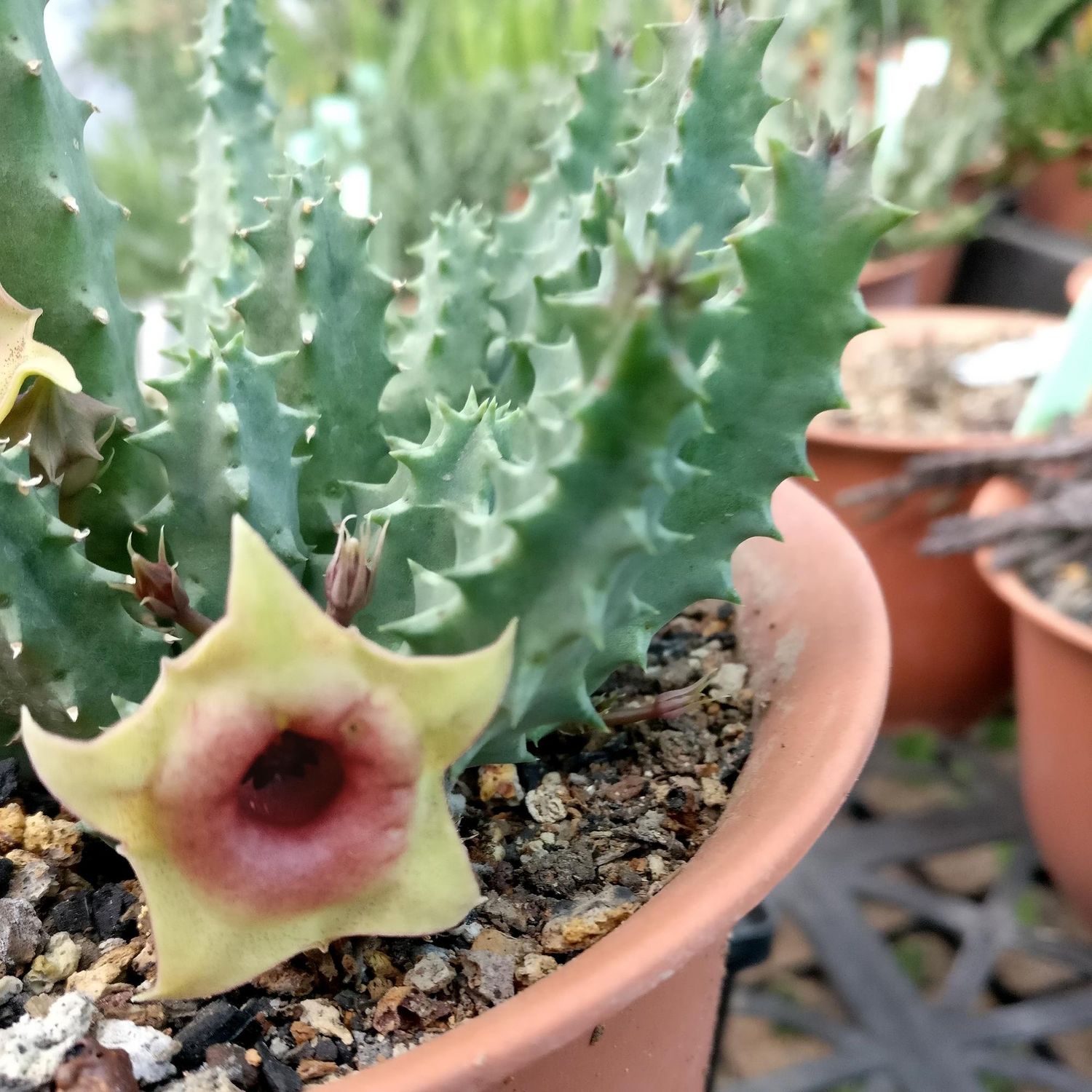
Huernia Hybrid 'Claret Star'
SKU ASC049
₹400.00
In stock: 1 available
1
Save this product for later
Customer reviews
Reviews only from verified customers
No reviews yet. You can buy this product and be the first to leave a review.
Huernia Hybrid 'Claret Star'
Product Details
Huernia Hybrid 'Claret Star'
A low, spreading cluster of soft-toothed, blue-green stems that vanishes into the background — until a single star-shaped bloom in buttery cream opens right at soil level, its centre stained deep wine-claret like a drop of red wine caught in glass.
Origin of Name
The genus name Huernia is a small, deliberate act of botanical mischief. It honours Justus Heurnius (1587–1652), a Dutch minister and physician who, during a stopover at Table Bay (Cape Town) in April 1624, made what is considered the first botanically useful collection of South African plants — carefully drawing and describing ten Cape species, including an early carrion flower relative, decades before systematic Cape botany began in earnest. His notes and sketches eventually surfaced in the Dutch botanist Johannes Bodaeus van Stapel's 1644 annotated edition of Theophrastus's Historia Plantarum — the very same posthumous work that gave the related genus Stapelia its name. When the Scottish botanist Robert Brown formally established the genus in 1810, he commemorated Heurnius by deliberately mis-spelling his name as "Huernia" rather than "Heurnia" — a common 19th-century convention for coining a smoother-sounding Latin genus name while still preserving the honouree's identity for anyone who went looking.
The plant offered here is a cultivated hybrid rather than a wild-collected species, so it carries no single published epithet of its own — it's bred within the genus, most likely drawing on parents such as Huernia zebrina, H. pillansii, and H. schneideriana for a bigger, brighter, or more strikingly patterned flower than any one wild species reliably produces. In the absence of a formal breeder's name, we've named it 'Claret Star' for exactly what it shows: five pale, star-pointed petals framing a deep, glossy claret-red centre, the kind of colour contrast collectors specifically breed and select for. Naming an unregistered cross by its most obvious visual trait is common practice across the modern hybrid succulent trade, especially among the prolific Thai nurseries that now produce so many of these plants for the world market.
Origin of Plant
Every Huernia species traces back to the dry scrub, stony grassland, and rocky outcrops of Eastern and Southern Africa, from Ethiopia and Somalia down through East Africa to South Africa and Namibia — arid, sun-baked terrain where these leafless, water-storing stems can hug the ground among rocks and low shrubs, easily overlooked until they flower. The genus was scientifically framed in Europe in 1810, but its story really begins two centuries earlier with Heurnius's 1624 Cape observations, at a time when Dutch East India Company ships routinely stopped at Table Bay and their passengers were among the first Europeans to record the region's extraordinary succulent flora.
This particular plant, however, has no African habitat of its own — it was bred and raised in Thailand, which over the past few decades has become one of the world's leading hubs for succulent and stapeliad hybridizing alongside its famous cactus and water lily breeding programs. Thai growers work with wild African Huernia lines under warm, humid, year-round growing conditions very different from the plant's arid native range, selecting seedlings for exactly the kind of bold, high-contrast flower colour seen here before propagating the best of them onward into the export trade.
Description
This is a low, mat-forming succulent built from soft, fleshy, four-to-five-angled stems in grey-green to blue-green, each angle lined with small, blunt, tooth-like tubercles rather than true spines — a texture that looks armed but is actually quite soft to the touch. Left to itself, it spreads and clusters into a dense, sprawling clump close to the soil.
The real spectacle is the flower, which opens flat and star-shaped directly at the base of the stems, often seeming disproportionately large for the plant that produced it. Five broad, slightly reflexed lobes in pale creamy yellow spread out from the centre, deepening at the throat into a glossy, raised annulus in rich claret-red that rings a dark, almost black-red corolla mouth — a striking bullseye pattern typical of the zebrina-type hybrids, and the very trait that earned this plant its 'Claret Star' name. Like all stapeliads, the bloom carries a faint carrion scent designed to attract flies rather than bees, part of an elaborate mimicry of rotting flesh that the whole tribe (Stapelieae, within the milkweed subfamily of the dogbane family, Apocynaceae) has evolved for pollination. Flowers typically appear through the warmer months and, while individually short-lived, a healthy clump can produce a steady, spaced-out succession of blooms.
Conservation Status
As a cultivated hybrid, this plant has no IUCN Red List assessment of its own — it is propagated entirely by cuttings and offsets in cultivation, never collected from the wild. Many of its wild Huernia parent species remain reasonably widespread across Eastern and Southern Africa, though a number of localized species are considered vulnerable due to habitat loss and over-collection, and international trade in wild-collected stapeliads is regulated under CITES Appendix II. Choosing a nursery-propagated hybrid like this one is always the more sustainable option, and it takes pressure off wild populations entirely.
Care
Light: Bright light with some protection from harsh, direct midday sun — a spot that gets strong morning or filtered light is ideal. Too little light produces soft, stretched, pale stems; too much harsh sun can scorch them.
Watering: Water moderately through spring and summer, letting the soil dry out fully between waterings — Huernias rot far more easily from overwatering than they suffer from being kept slightly dry. Cut back sharply in winter, watering only sparingly, roughly once a month, while the plant rests.
Soil: A very free-draining, mineral-rich succulent or cactus mix, ideally in an unglazed terracotta pot that lets excess moisture escape through its walls as well as the drainage hole.
Temperature: A warm grower that dislikes cold, damp conditions; keep it above about 10°C (50°F) in winter, and always prioritise drainage over humidity.
General tips: Propagates very easily from stem cuttings taken during the growing season — simply let a cutting callus over for a day or two before setting it on top of dry, gritty soil to root. This is also the easiest way to keep the clump full and shareable with fellow collectors.
An Interesting Note
There's a neat historical thread running through this plant's name: Justus Heurnius's original 1624 Cape plant notes — the ones that eventually earned him this genus — were published in the same 1644 book that gave the related genus Stapelia its own name, honouring the book's editor, Johannes Bodaeus van Stapel. Two of the most beloved "carrion flower" genera in succulent collections worldwide, still frequently grown and hybridized side by side today, both trace their names back to the same slim seventeenth-century Dutch botanical volume — a small, curious link between a pair of plants separated by continents in the wild but united on the same page of botanical history.
You May Also Like

FORTIFIED Cactus & Succulent SOIL (FINE)
FORTIFIED Cactus & Succulent SOIL (FINE)
SKU MNS002
5.0
(4)
₹49.85

Cactus Seed Planting Mix
Cactus Seed Planting Mix
Sterile, Fine-Grain Media for Cactus & Succulent Seeds
SKU MNS005
₹74.85
New


Monsoon Guardian Kit (5 in 1)
Monsoon Guardian Kit (5 in 1)
Complete 5-in-1 biological protection kit for cacti & succulents
SKU MNS024
₹850.00


Cactus & Succulent Planting Mix FINE (aka Cactus Soil Mix or Succulent Soil Mix)
Cactus & Succulent Planting Mix FINE (aka Cactus Soil Mix or Succulent Soil Mix)
Fine-Grain Potting Mix for Cactus & Succulent Roots
SKU MNS001
5.0
(3)
₹39.85
Display prices in:INR
