
Categories
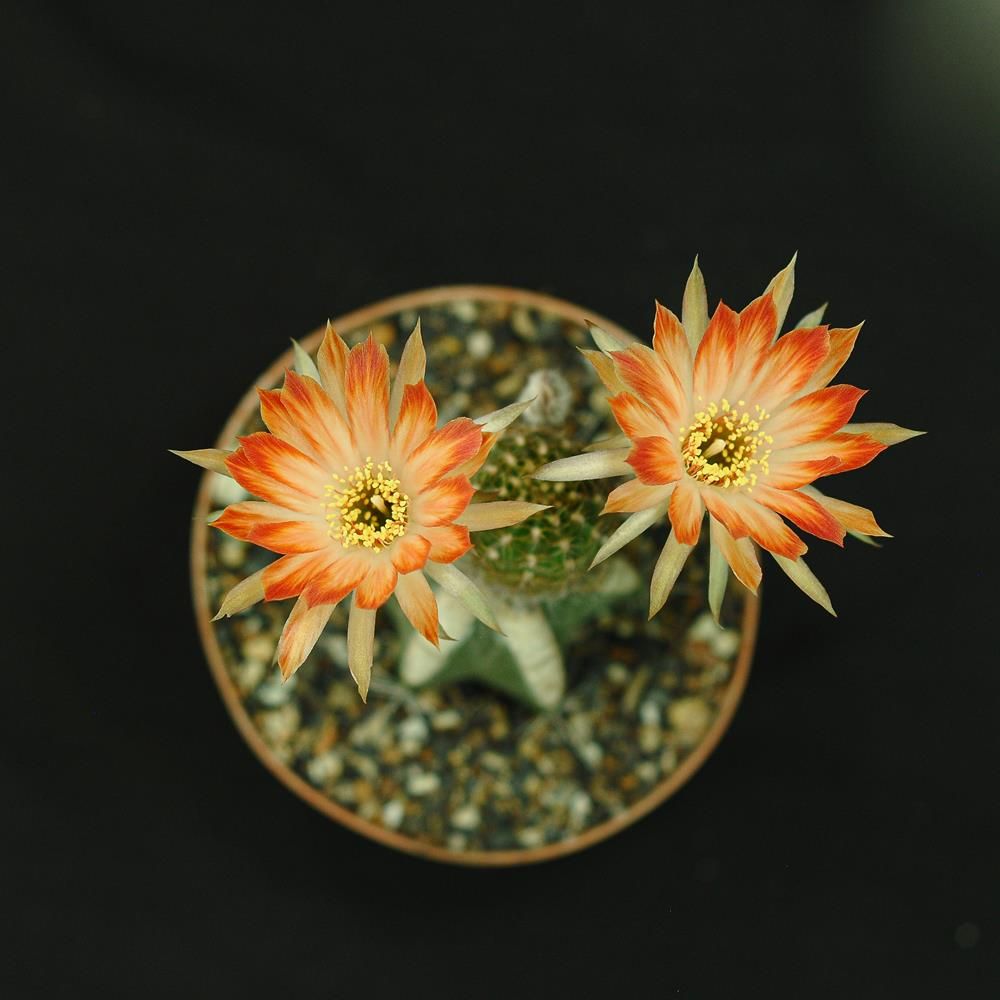
Lobivia Luz del volcán
SKU LET093
₹350.00
In stock: 1 available
1
Save this product for later
Customer reviews
Reviews only from verified customers
No reviews yet. You can buy this product and be the first to leave a review.
Lobivia Luz del volcán
Product Details
A wide, star-shaped bloom that looks lit from within — glowing orange-red deepening toward the petal bases, fading outward into smoky, ash-toned tips, with a dark, glowing core of golden-yellow stamens at the center. A Lobivia hybrid whose name, Spanish for "light of the volcano," seems to describe exactly what's happening at the heart of each flower.
Origin of Name
'Luz del volcán' — Spanish for "light of the volcano" — is a cultivar name rather than a botanical one, chosen to capture the flower's presence rather than to describe it scientifically. The name draws on a striking bit of visual logic: the bloom's fiery orange-red core, ringed by petal tips fading to a pale, smoky tan, mirrors the look of molten light glowing up through drifting ash — an image right at home in the genus's own geography. True Lobivia species grow wild across the high Andes of Bolivia, Peru, and northern Argentina, terrain shaped by some of the highest and most active volcanic landscapes on Earth, from Bolivia's Sajama to the smoking cone of Ollagüe on the Chile–Bolivia border. Naming a hybrid after volcanic light is less imaginative leap than a nod to the terrain its wild ancestors actually call home. As with many collector-traded Lobivia and Echinopsis hybrids, no formally published breeding record for this specific clone is part of the wider literature — it circulates on the strength of the flower alone.
The genus name it's sold under, Lobivia, is a straightforward anagram of Bolivia, coined in 1922 by American botanists Nathaniel Lord Britton and Joseph Nelson Rose to honor the country where so many of the group's wild species are found. Its taxonomic status has shifted repeatedly since — folded into Echinopsis, split back out in 2016, then merged back into Echinopsis again in a 2025 reclassification now followed by Kew. Whatever label currently applies, plants sold as "Lobivia hybrids" earn that name for exactly this trait: big, vividly colored flowers on compact, easy-to-grow bodies.
Origin of Plant
Like all hybrid Lobivias, 'Luz del volcán' has no wild habitat of its own — a deliberately bred garden cross rather than a species collected from nature. Its genetics trace to true Lobivia species native to the high grasslands, rocky outcrops, and volcanic slopes of southern Peru, western Bolivia, and northwestern Argentina, rooting into thin, mineral soils often above 3,000 meters, enduring intense high-altitude sun by day and sharp frosts by night. Decades of hybridizing have pushed that wild gene pool toward ever larger, more richly colored blooms on compact, clump-forming plants — the lineage this hybrid belongs to.
Description
The plant itself stays low and modest: a small, ribbed, spine-studded stem that offsets readily into a tight clustering clump, easy to overlook most of the year until it flowers. The bloom does the talking — opening wide and flat into a many-pointed star, with narrow, sharply tapered petals glowing deep orange-red near the base and fading outward through amber into pale, smoky, olive-tan tips, closer to embers cooling at the edges than a uniform block of color. At the center, a dark, shadowed throat gives way to a dense cluster of golden-yellow stamens — a genuine spark against the warm tones. As with the rest of the Lobivia/Echinopsis group, each flower lasts only about a day, but a well-grown clump can open several at once.
Conservation Status
As a cultivated hybrid propagated by offsets, it has no IUCN status of its own. Its wild Lobivia ancestors aren't currently classified as broadly threatened, though wild-collected cacti trade generally is regulated under CITES Appendix II. A nursery-raised hybrid is always the sustainable choice.
Care
Light: Bright light is essential for strong flowering — several hours of direct sun daily, with relief from harsh midday sun in very hot climates.
Watering: Water thoroughly spring–early autumn, drying fully between waterings; cut back sharply and keep nearly dry in winter.
Soil: Gritty, fast-draining cactus mix cut generously with pumice, perlite, or coarse sand.
Temperature: Comfortable in average warm-season conditions; decent cold tolerance from its high-Andean ancestry, but keep dry and frost-free.
General tips: Feed lightly with diluted, low-nitrogen fertilizer during the growing season. Offsets can be detached once rooted and potted separately.
An Interesting Note
The volcanic highlands this hybrid's wild ancestors call home are among the most extreme growing conditions any cactus faces — thin air, ferocious ultraviolet light, mineral-poor volcanic soil, and daily temperature swings that can cross 30°C between a scorching noon and a freezing night. Cacti here don't just tolerate that terrain, they've built their entire survival strategy around it, hugging low to the ground and packing themselves with water reserves for exactly the kind of exposure that would kill most other plants outright. There's a certain honesty in a flower this vivid naming itself after the fire beneath that landscape — even the ground these plants grow from has never entirely gone quiet.
You May Also Like
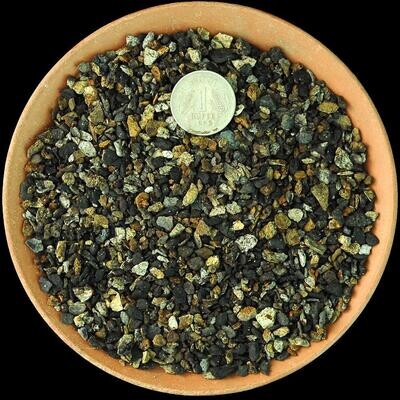
Cactus & Succulent Planting Mix COARSE (aka Cactus Soil Mix or Succulent Soil Mix)
Cactus & Succulent Planting Mix COARSE (aka Cactus Soil Mix or Succulent Soil Mix)
Washed, Free-Draining Mineral Mix for Cactus & Succulents
SKU MNS003
5.0
(1)
₹44.85

FORTIFIED Cactus & Succulent SOIL (COARSE)
FORTIFIED Cactus & Succulent SOIL (COARSE)
SKU MNS004
5.0
(11)
₹54.85
New

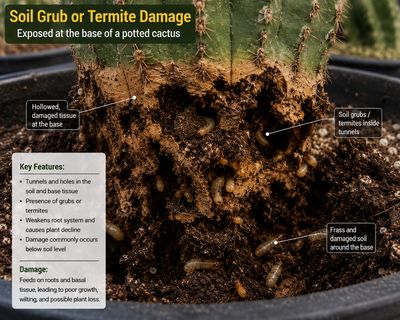
Monsoon Guardian Kit (5 in 1)
Monsoon Guardian Kit (5 in 1)
Complete 5-in-1 biological protection kit for cacti & succulents
SKU MNS024
₹850.00
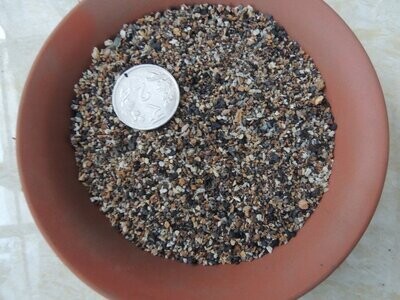
Cactus Seed Planting Mix
Cactus Seed Planting Mix
Sterile, Fine-Grain Media for Cactus & Succulent Seeds
SKU MNS005
₹74.85
Display prices in:INR
