
Categories
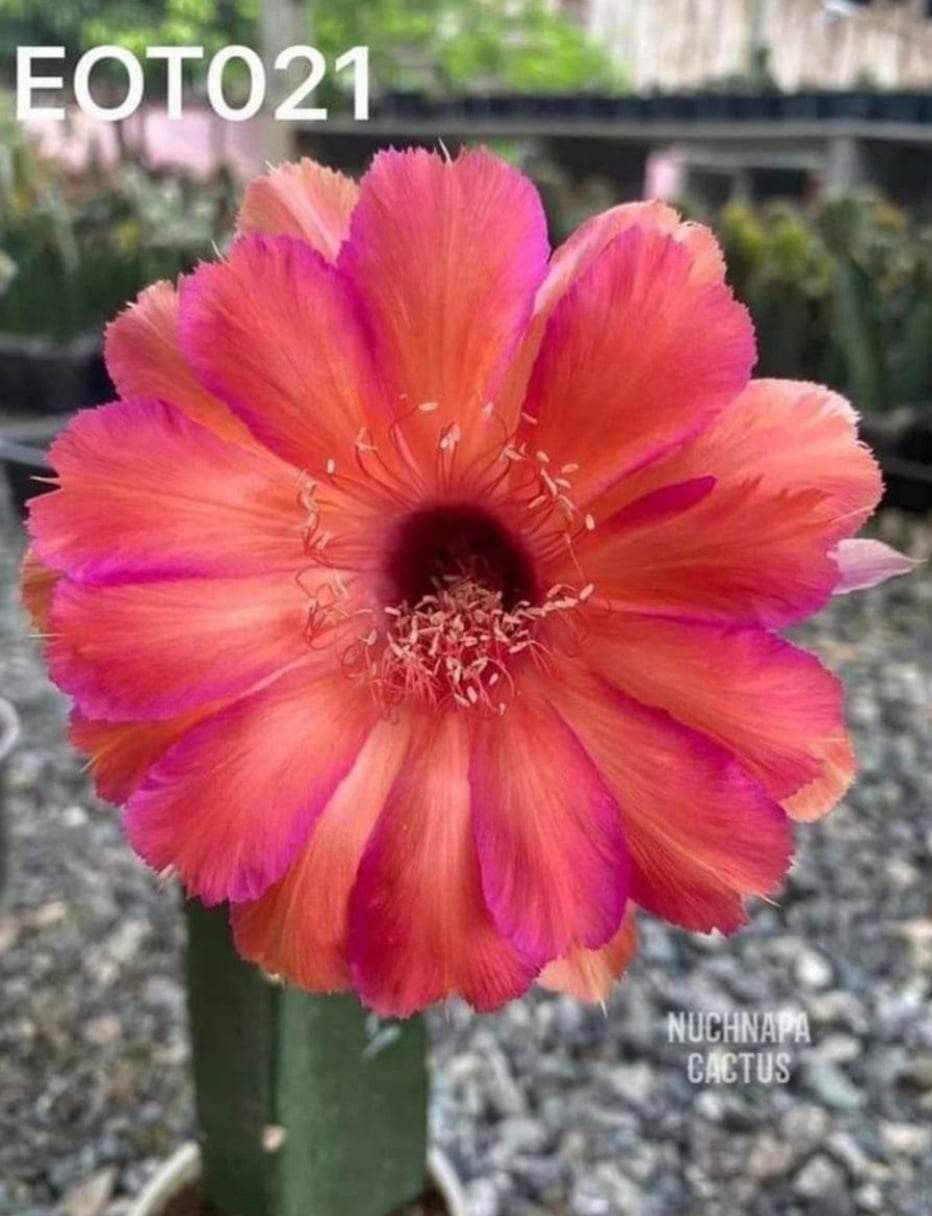
Lobivia hybrid EOT021
SKU LET365
₹750.00
Sold out
Sold out
Save this product for later
Customer reviews
Reviews only from verified customers
No reviews yet. You can buy this product and be the first to leave a review.
Lobivia hybrid EOT021
Product Details
Lobivia Hybrid 'EOT021'
A vivid, deep-throated bloom in coral, magenta, and burnt orange — each petal blushing from bright pink edges into a warm salmon centre, drawing the eye down into a dramatic near-black throat. 'EOT021' brings a bold, jewel-toned intensity that stands out even within a genus known for colour.
Origin of Name
The genus name Lobivia is an anagram of Bolivia, coined by botanists Nathaniel Britton and Joseph Rose in 1922 to honour the country home to the majority of the genus's wild species — one of the more playful naming decisions in botanical history, built as wordplay rather than derived from Greek or Latin roots. Modern molecular taxonomy has since folded most Lobivia species into the broader genus Echinopsis (from the Greek echinos, "hedgehog," and opsis, "appearance," describing the spiny, globular young growth typical of the group), though "Lobivia" remains in wide use among growers and hybridizers for its precision in describing this particular style of compact, clustering, richly-flowered cactus.
The designation 'EOT021' is a hybridizer's working seedling code rather than a formally registered cultivar name.
Origin of Plant
Wild Lobivia species are native to the high-altitude regions of Bolivia, Peru, and northern Argentina, growing as low, clustering cacti wedged into rocky mountain terrain, frequently above 3,000 metres. At these elevations, plants endure intense UV exposure, sharp day-to-night temperature swings, and thin, fast-draining soils — conditions that have shaped the genus's compact form, thick water-storing tissue, and tendency to offset into dense clumps over time.
'EOT021,' however, is a cultivated hybrid, the product of deliberate crossing between selected Lobivia/Echinopsis parent lines rather than a wild-collected species. Its origin lies in a hybridizer's breeding programme rather than a mountainside — one more seedling in the long tradition of hand-pollinating Lobivia flowers in pursuit of ever bolder and more saturated colour combinations, of which this deep pink-to-orange bloom is a striking result.
Description
'EOT021' produces a large, richly saturated flower with broad, slightly pointed petals that shift dramatically across their length: hot magenta-pink along the outer edges softening into warm coral and salmon-orange toward the base, creating a sunset-like gradient across each petal. At the very centre, the colour deepens sharply into an almost black-maroon throat, a dramatic pool of dark colour that sets off the surrounding warm tones and draws the eye straight into the heart of the bloom. Pale, thread-like stamens rise from this dark centre in loose disarray, adding a delicate textural contrast to the flower's otherwise bold colour palette.
The overall form is a wide, open, single-layered rosette rather than a dense double bloom, letting the strong petal colouring and dark throat take full visual precedence. As with most Lobivia-type hybrids, the flower is short-lived — typically open for a single day — but its intensity of colour makes it a standout even in brief bloom.
Conservation Status
The Cactaceae family is protected under CITES Appendix II, regulating international trade in wild-collected specimens. As an artificially propagated hybrid, 'EOT021' carries no wild population and presents no conservation concern of its own, typically qualifying for the artificially propagated exemption under CITES when sold — allowing collectors to enjoy this striking colour combination without any impact on wild Lobivia populations across the Andes.
Care
- Light: Full sun to very bright light is essential for compact growth and strong, well-saturated flowering; insufficient light results in stretched growth and paler, less vivid blooms.
- Watering: Water thoroughly during the growing season (spring through early autumn), letting the soil dry out completely between waterings. Reduce sharply in winter to support the plant's natural dormant rest, which also helps ensure strong flowering the following season.
- Soil: A fast-draining, mineral-rich cactus mix — heavy on pumice, grit, or coarse sand — is essential. Terracotta pots are preferred over plastic, as their porous walls allow excess moisture to evaporate rather than linger around the roots.
- Temperature: Grows best between 18–28°C; tolerates cool winter conditions well provided it is kept dry, reflecting its high-altitude origins.
- Feeding: A diluted, low-nitrogen, phosphorus-leaning cactus fertilizer in spring supports both offsetting growth and strong bud development.
A Story Worth Telling
The dramatic dark throat seen in 'EOT021' is a trait Lobivia hybridizers prize precisely because it's so visually effective and so difficult to predict from a cross — a deep, near-black centre against bright petal colour creates a bullseye effect that photographs and sells exceptionally well, but tends to emerge unpredictably even from carefully chosen parent plants. Coded seedlings like this one represent the unglamorous middle stage of that process: grown on for years past their first bloom, watched closely through subsequent flowering seasons to confirm the trait holds true, long before a grower commits to giving them a name worth remembering.
You May Also Like
New


Monsoon Guardian Kit (5 in 1)
Monsoon Guardian Kit (5 in 1)
Complete 5-in-1 biological protection kit for cacti & succulents
SKU MNS024
₹850.00

FORTIFIED Cactus & Succulent SOIL (FINE)
FORTIFIED Cactus & Succulent SOIL (FINE)
SKU MNS002
5.0
(4)
₹49.85

FORTIFIED Cactus & Succulent SOIL (COARSE)
FORTIFIED Cactus & Succulent SOIL (COARSE)
SKU MNS004
5.0
(11)
₹54.85

Cactus & Succulent Planting Mix COARSE (aka Cactus Soil Mix or Succulent Soil Mix)
Cactus & Succulent Planting Mix COARSE (aka Cactus Soil Mix or Succulent Soil Mix)
Washed, Free-Draining Mineral Mix for Cactus & Succulents
SKU MNS003
5.0
(1)
₹44.85
Display prices in:INR
