
Categories
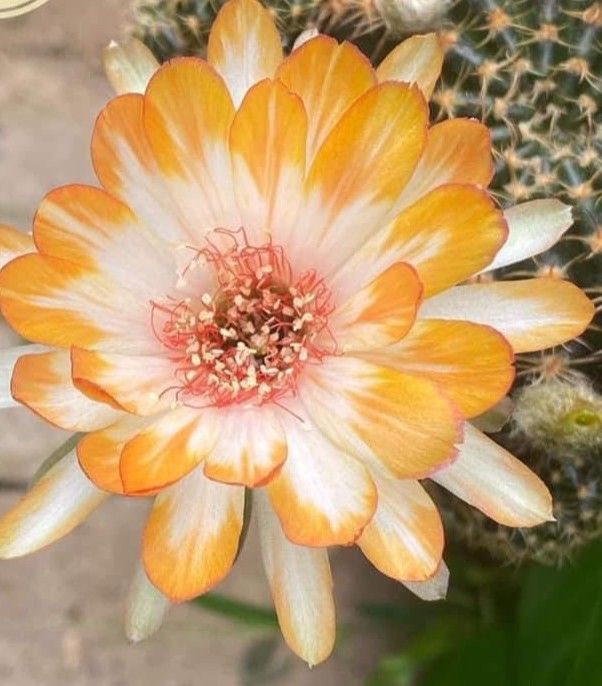
Lobivia hybrid Helios
SKU LET259
₹650.00
Sold out
Sold out
Save this product for later
Customer reviews
Reviews only from verified customers
No reviews yet. You can buy this product and be the first to leave a review.
Lobivia hybrid Helios
Product Details
A wide, sun-disc bloom in glowing amber and cream, its slender red-tipped stamens radiating from the center like rays — a Lobivia hybrid whose flower looks like it was named after the sun before anyone even saw it open.
Origin of Name
'Helios' takes its name from the Greek god of the sun, who in myth drove a blazing golden chariot across the sky each day — a fitting namesake for a flower built almost entirely around radiating warm light. The bloom's broad, sunburst form and its gradient from creamy white through amber-orange, with a fine web of thread-like red stamens at the center, echoes both the sun's disc and its rays. Cultivar names drawn from mythology are a common choice among Echinopsis and Lobivia hybridizers looking to match a name to a flower's presence, and as with many collector-traded hybrids, no formally published breeding record for this specific clone is part of the wider literature.
The genus name it's sold under, Lobivia, is a straightforward anagram of Bolivia, coined in 1922 by American botanists Nathaniel Lord Britton and Joseph Nelson Rose. Its taxonomic status has shifted repeatedly since — folded into the larger genus Echinopsis, split back out in 2016, then merged into Echinopsis again in a 2025 reclassification now followed by Kew. Whatever label currently applies, plants sold as "Lobivia hybrids" earn that name for exactly this trait: big, vividly colored flowers on compact, easy-to-grow bodies.
Origin of Plant
Like all hybrid Lobivias, 'Helios' has no wild habitat of its own — it's a deliberately bred garden cross rather than a species collected from nature. Its genetics trace to true Lobivia species native to the high grasslands and rocky slopes of southern Peru, western Bolivia, and northwestern Argentina, adapted to intense sun and sharp Andean temperature swings. Decades of hybridizing have pushed that wild gene pool toward ever larger, more richly colored blooms on compact, clump-forming plants — the lineage 'Helios' belongs to.
Description
The plant itself stays modest: a small, ribbed, spine-studded stem that offsets readily into a low clustering clump, easy to overlook until it flowers.
The bloom is the point. It opens wide and flat, with broad petals shading from pale cream at the base through warm amber and finishing in soft orange-red tips — a genuine sunburst gradient. At the center, fine, hair-like red-tinged stamens radiate outward around a paler stigma, adding to the sun-ray effect. As with the rest of the Lobivia/Echinopsis group, each flower is short-lived, typically open for only a day, with fresh buds following through the growing season.
Conservation Status
As a cultivated hybrid propagated by offsets, 'Helios' has no IUCN Red List status of its own. Its wild Lobivia ancestors aren't currently classified as broadly threatened, though international trade in wild-collected cacti generally is regulated under CITES Appendix II. A nursery-raised hybrid like this one is always the sustainable choice.
Care
Light: Bright light is essential for strong flowering — several hours of direct sun daily, with a little relief from the harshest midday sun in very hot climates.
Watering: Water thoroughly through spring–early autumn, letting the soil dry out completely between waterings. Cut back sharply in winter, keeping the plant nearly dry while dormant.
Soil: A gritty, fast-draining cactus mix — potting soil cut generously with pumice, perlite, or coarse sand.
Temperature: Comfortable in average warm-season conditions; its high-Andean ancestry gives it decent cold tolerance, but keep it dry and frost-free.
General tips: Feed lightly with a diluted, low-nitrogen fertilizer during the growing season to support strong bud production. Offsets can be detached once rooted and potted separately.
An Interesting Note
There's a neat logic in naming a cactus flower after Helios rather than Apollo, the god who later absorbed his sun-driving duties in Greek myth. Helios is the older, plainer figure — defined by nothing but the light he carries across the sky, with no other domain to his name. A flower this singularly built around warmth and radiance suits that older, more literal god better than a more complicated one.
You May Also Like

FORTIFIED Cactus & Succulent SOIL (COARSE)
FORTIFIED Cactus & Succulent SOIL (COARSE)
SKU MNS004
5.0
(11)
₹54.85

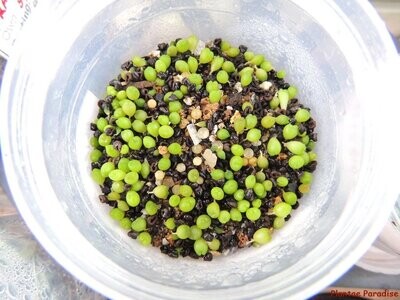
Cactus Seed Planting Mix
Cactus Seed Planting Mix
Sterile, Fine-Grain Media for Cactus & Succulent Seeds
SKU MNS005
₹74.85
New


Monsoon Guardian Kit (5 in 1)
Monsoon Guardian Kit (5 in 1)
Complete 5-in-1 biological protection kit for cacti & succulents
SKU MNS024
₹850.00


Cactus & Succulent Planting Mix FINE (aka Cactus Soil Mix or Succulent Soil Mix)
Cactus & Succulent Planting Mix FINE (aka Cactus Soil Mix or Succulent Soil Mix)
Fine-Grain Potting Mix for Cactus & Succulent Roots
SKU MNS001
5.0
(3)
₹39.85
Display prices in:INR
