
Categories
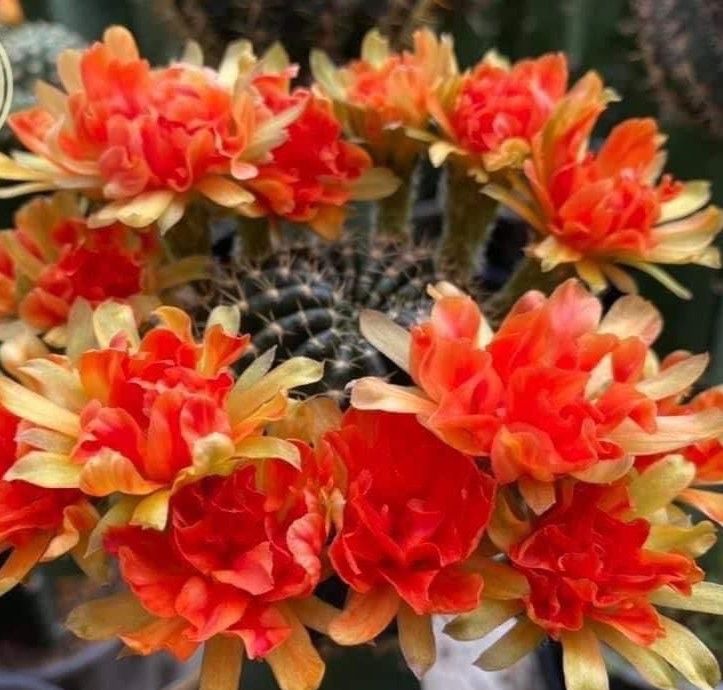
Lobivia hybrid Pyrlig
SKU LET274
₹700.00
Sold out
Sold out
Save this product for later
Customer reviews
Reviews only from verified customers
No reviews yet. You can buy this product and be the first to leave a review.
Lobivia hybrid Pyrlig
Product Details
A small spiny globe all but disappears beneath its own flowers — a dense crown of fully double, ruffled blooms in fierce tangerine-red fading to a frilled yellow-green fringe. This Lobivia hybrid is bred for drama: a dozen or more flame-colored blooms can open together atop a single small stem.
Origin of Name
"Pyrlig" is a distinctly Welsh-sounding cultivar name, most likely borrowed from Father Pyrlig — the boisterous Welsh warrior-priest in Bernard Cornwell's Saxon Stories (adapted for TV as The Last Kingdom), a former fighter turned court chaplain who never quite hung up his sword. It's a fitting namesake for a flower this loud and unrestrained. Hybridizers often reach for literary or pop-culture names to mark out a striking clone, and as with many collector-traded hybrids, no formally published breeding record for this particular plant is part of the wider literature — the name travels on the flower's reputation alone.
The genus name Lobivia has cleaner documented roots: a straightforward anagram of Bolivia, coined in 1922 by American botanists Nathaniel Lord Britton and Joseph Nelson Rose. Its taxonomic status has flip-flopped ever since — absorbed into Echinopsis, split back out in 2016, then folded into Echinopsis again in a 2025 reclassification now followed by Kew. Whatever the current consensus, plants sold as "Lobivia hybrids" earn that name for exactly this trait: exuberant, colorful flowers on compact, easy-to-house bodies.
Origin of Plant
Like all hybrid Lobivias, 'Pyrlig' has no wild habitat of its own — it's a deliberately bred garden cross, not a species collected in nature. Its genetics trace to true Lobivia species native to the high grasslands and rocky slopes of southern Peru, western Bolivia, and northwestern Argentina, adapted to intense sun, thin soils, and sharp Andean temperature swings. This particular plant also carries a deliberately bred "doubling" trait, where stamens convert into extra petals — the mutation hybridizers have long selected for to produce dense, peony-like blooms like these, in place of the simpler, single-layered flowers of the wild species.
Description
'Pyrlig' grows as a small, low, ribbed, heavily spined stem that clumps modestly from the base but stays compact, putting its energy into flowering rather than bulk.
The flowers do the talking. Each bloom opens fully double and densely ruffled — many overlapping layers of narrow, waved petals, closer in texture to a ranunculus or peony than a typical cactus flower. Color runs hot: fiery orange-red through the inner petals, warming to gold, and finishing in a fringe of pale yellow-green at the tips. This hybrid flushes heavily, often opening a dozen or more blooms together in one crown that can hide the spiny body beneath entirely. As with the wider Lobivia/Echinopsis group, individual flowers are short-lived — a day or two — with fresh flushes following through the growing season.
Conservation Status
As a cultivated hybrid propagated by offsets and cuttings, 'Pyrlig' has no IUCN Red List status of its own. Its wild Lobivia ancestors aren't currently classified as broadly threatened, though international trade in wild-collected cacti generally is regulated under CITES Appendix II. A nursery-raised hybrid like this one is always the sustainable choice.
Care
Light: Bright light is essential for heavy flowering — several hours of sun daily, with a little relief from the harshest midday sun in very hot climates.
Watering: Water thoroughly through spring–early autumn, letting the soil dry out completely between waterings. Cut back sharply in winter, keeping the plant almost dry while dormant.
Soil: A gritty, fast-draining cactus mix — potting soil cut generously with pumice, perlite, or coarse sand.
Temperature: Comfortable in average warm-season temperatures; its high-Andean ancestry gives it decent cold tolerance, but keep it dry and frost-free.
General tips: Feed lightly with a diluted, low-nitrogen fertilizer during the growing season to support a strong bloom flush. Offsets can be detached once rooted and potted separately.
An Interesting Note
There's a nice symmetry here: Father Pyrlig is a man of contradictions worn comfortably — holy and hard-fighting at once. A fully double Lobivia bloom is much the same trick in floral form — parts that would normally do a different job (the stamens) reshaped into pure, ruffled spectacle. Both take something expected to be plain and turn it into a performance no one can ignore.
You May Also Like
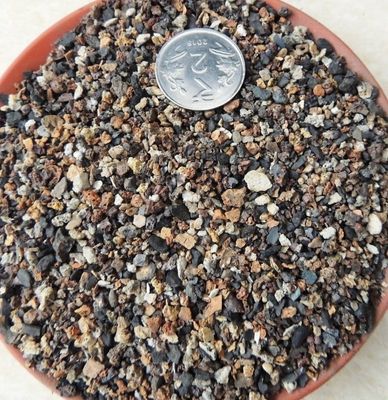
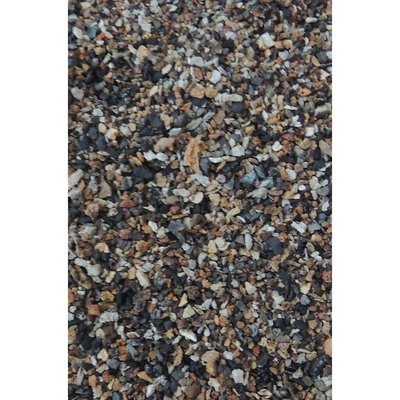
Cactus & Succulent Planting Mix FINE (aka Cactus Soil Mix or Succulent Soil Mix)
Cactus & Succulent Planting Mix FINE (aka Cactus Soil Mix or Succulent Soil Mix)
Fine-Grain Potting Mix for Cactus & Succulent Roots
SKU MNS001
5.0
(3)
₹39.85
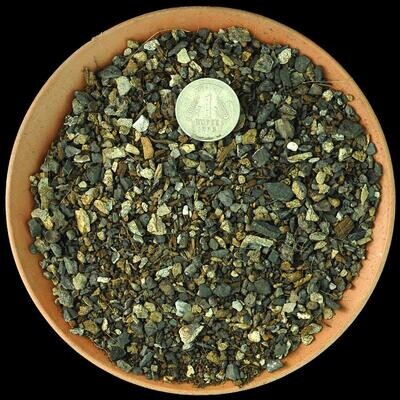
FORTIFIED Cactus & Succulent SOIL (COARSE)
FORTIFIED Cactus & Succulent SOIL (COARSE)
SKU MNS004
5.0
(11)
₹54.85

FORTIFIED Cactus & Succulent SOIL (FINE)
FORTIFIED Cactus & Succulent SOIL (FINE)
SKU MNS002
5.0
(4)
₹49.85

Cactus & Succulent Planting Mix COARSE (aka Cactus Soil Mix or Succulent Soil Mix)
Cactus & Succulent Planting Mix COARSE (aka Cactus Soil Mix or Succulent Soil Mix)
Washed, Free-Draining Mineral Mix for Cactus & Succulents
SKU MNS003
5.0
(1)
₹44.85
Display prices in:INR
