
Categories
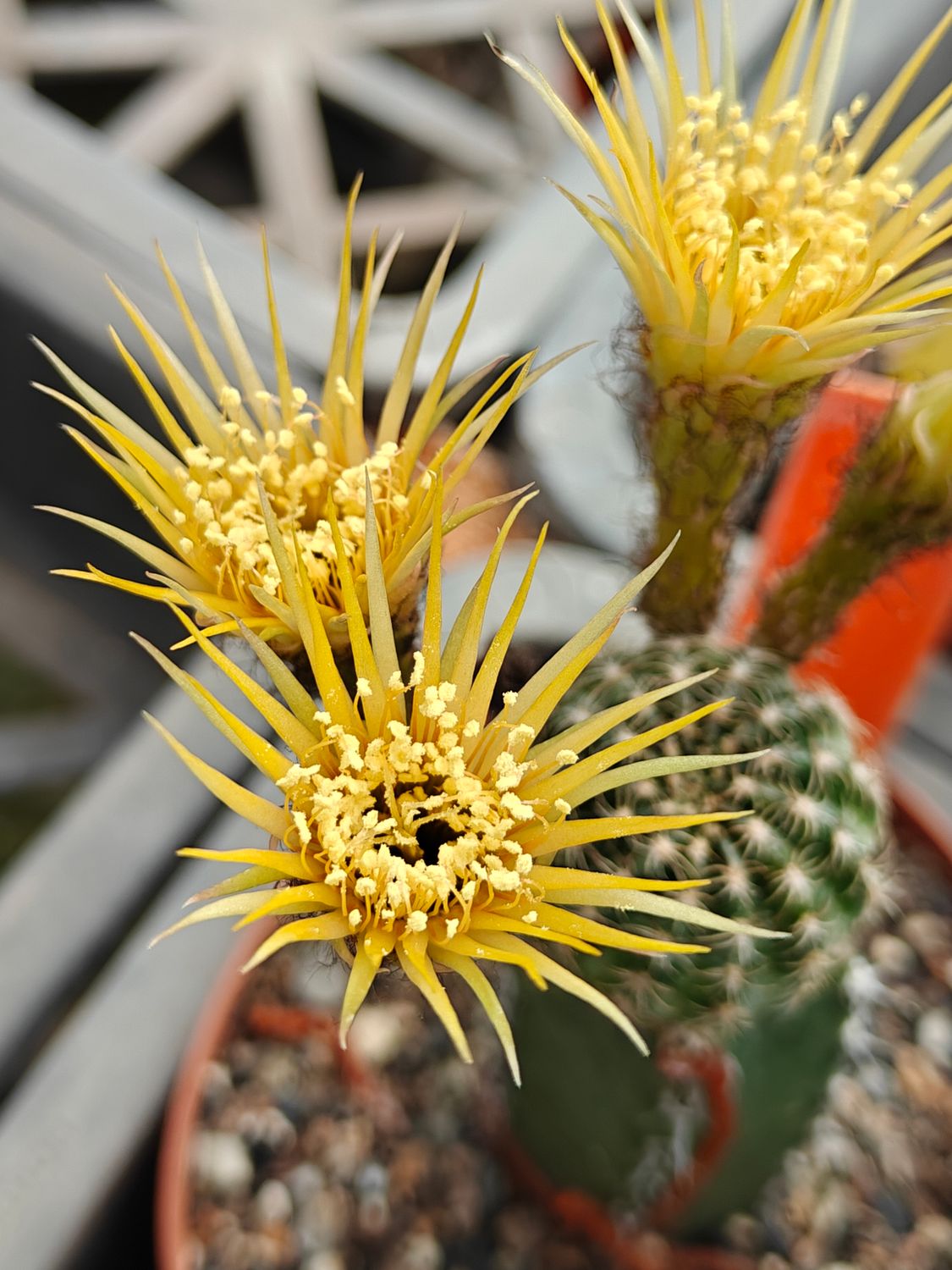
Lobivia hybrid Shinshowa yellow
SKU LET439
₹750.00
In stock: 1 available
1
Save this product for later
Customer reviews
Reviews only from verified customers
No reviews yet. You can buy this product and be the first to leave a review.
Lobivia hybrid Shinshowa yellow
Product Details
Here's the listing for Lobivia hybrid 'Shinshowa' (Yellow):
A flower made entirely of light — this is what happens when a cactus bloom loses its petals and grows a hundred golden threads instead. Shinshowa's blossoms open flat and starry, each one a dense radiating burst of impossibly fine, hair-thin filaments in sunlit yellow, clustered so tightly around the flower's centre that the plant seems to be blooming pure texture rather than colour. It's an oddity in the best collector sense: a flower that photographs like nothing else in the genus.
Origin of Name
Lobivia, the genus name attached to this hybrid, is a well-known anagram of Bolivia — coined by botanists Nathaniel Britton and Joseph Rose in 1922 to flag the plant's Andean homeland while giving it a name distinct enough to stand as its own genus. The cultivar name Shinshowa, however, comes from an entirely different linguistic tradition: Japanese cactus horticulture. "Shin" translates roughly to "extremely" or "super," while "sho" (rendered "showa" here) means "thin," the combination describing precisely what makes this hybrid stand apart — petals reduced to fine, wiry, almost hair-like threads rather than the broad, flat form typical of most Echinopsis and Lobivia flowers. This is not an isolated naming quirk: the same descriptive term appears across the hybridizing world, most notably in Astrophytum asterias cultivars, where "Shinshowa" and its shortened form "Showa" describe asterias flowers cut into fine, threadlike shreds — a parallel invention arising from the same aesthetic obsession with ultra-fine petal texture. The plant also circulates under the alternate name Echinopsis cv. Stern von Lorsch ("Star of Lorsch" in German), a nod to the same starburst silhouette described from a European breeding tradition.
Origin of Plant
Shinshowa is a hybrid cultivar, its precise breeding history not formally published, but its parentage draws on wild Lobivia and Echinopsis species native to the high-altitude regions of Bolivia, Peru, and Argentina. These wild ancestors evolved on rocky, sun-blasted slopes at significant elevation, where thin air, intense UV exposure, and sharp day-night temperature swings shaped compact, spine-armored, ball-forming growth habits. Fine-petalled cultivars like Shinshowa emerged from generations of selective breeding — much of it pioneered in Japanese and European nurseries — isolating and stabilising the thread-petal trait until it bred true.
Description
The plant body is a modest, globular to shortly columnar stem, ribbed and studded with fine spines, entirely secondary to the display it produces each flowering season. The flowers themselves are the plant's whole reason for being: wide, flattened, star-shaped blooms composed of dozens of narrow, needle-fine yellow petals radiating outward from a dense, golden central boss of stamens. Rather than overlapping into a solid disc, the petals stay separate and threadlike along their full length, giving the open flower a spiky, almost anemone-like or sea-urchin texture entirely unlike the smooth-edged blooms of most Echinopsis relatives. Multiple flowers frequently open together along the crown of the stem, as seen in specimens carrying two or more synchronized blooms at once.
Conservation Status
As a cultivated hybrid with no wild population of its own, Shinshowa is not individually assessed for conservation status. Its Lobivia and Echinopsis parent genera fall under CITES Appendix II, governing international trade in wild-collected material to protect native Andean populations from over-harvesting. This nursery-propagated hybrid qualifies for the artificially propagated exemption, meaning it can be freely traded and collected without the restrictions applied to wild specimens.
Care
Light: Full sun to very bright light; strong exposure sustains tight growth and encourages generous flowering
Watering: Water thoroughly in spring and summer once the soil has dried out; cut back sharply in winter to little or no water
Soil: Fast-draining, mineral-heavy cactus mix — avoid rich, moisture-retentive potting soils
Pot: Terracotta is preferable to plastic, helping excess moisture evaporate from the root zone
Temperature: Prefers warm, bright summers with a cool, dry winter rest to trigger strong spring flowering
Feeding: Low-nitrogen, high-potassium fertiliser through the growing season, applied sparingly, to support flower bud development over vegetative bulk
A Story Worth Telling
The "shinshowa" petal form isn't unique to Lobivia — it's a trait breeders have chased across entirely different cactus genera, most famously in Astrophytum asterias, where a grower named T. Sato discovered a rare red-flowered form of the same thin-petalled mutation, prized as one of the few red-blooming Astrophytum in existence. That the same word, the same aesthetic ideal, surfaces independently in two unrelated cactus lineages says something about the international, almost obsessive culture of ornamental cactus breeding — hybridizers on opposite sides of the world, working with entirely different plants, converging on the exact same descriptive language for the exact same delicate, threadlike beauty. It's a small reminder that "rare" in the collector's world often means something more specific than scarcity: it means a trait so particular that only a handful of people, chasing it for its own sake, ever manage to fix it in a stable, repeatable line.
You May Also Like
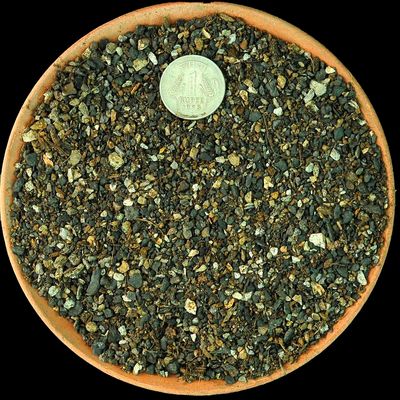
FORTIFIED Cactus & Succulent SOIL (FINE)
FORTIFIED Cactus & Succulent SOIL (FINE)
SKU MNS002
5.0
(4)
₹49.85
New

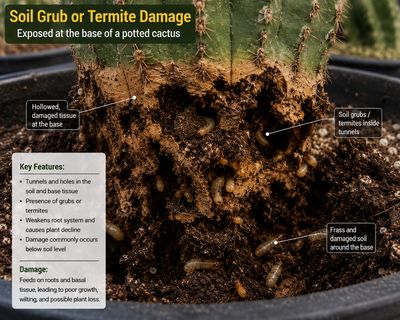
Monsoon Guardian Kit (5 in 1)
Monsoon Guardian Kit (5 in 1)
Complete 5-in-1 biological protection kit for cacti & succulents
SKU MNS024
₹850.00
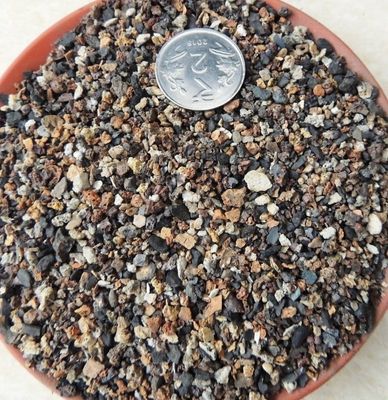
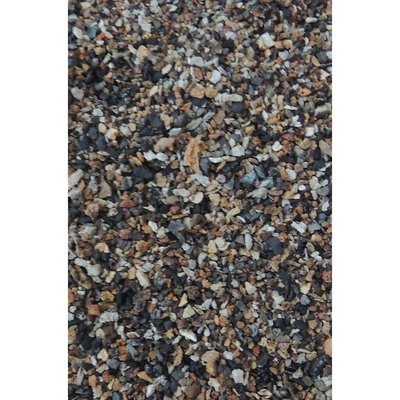
Cactus & Succulent Planting Mix FINE (aka Cactus Soil Mix or Succulent Soil Mix)
Cactus & Succulent Planting Mix FINE (aka Cactus Soil Mix or Succulent Soil Mix)
Fine-Grain Potting Mix for Cactus & Succulent Roots
SKU MNS001
5.0
(3)
₹39.85
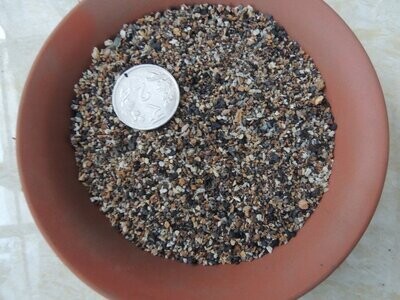
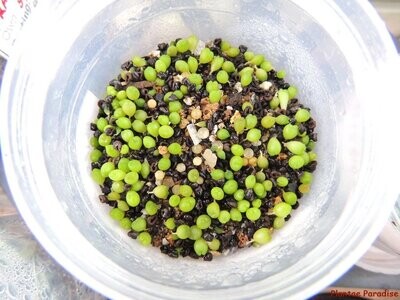
Cactus Seed Planting Mix
Cactus Seed Planting Mix
Sterile, Fine-Grain Media for Cactus & Succulent Seeds
SKU MNS005
₹74.85
Display prices in:INR
