
Categories
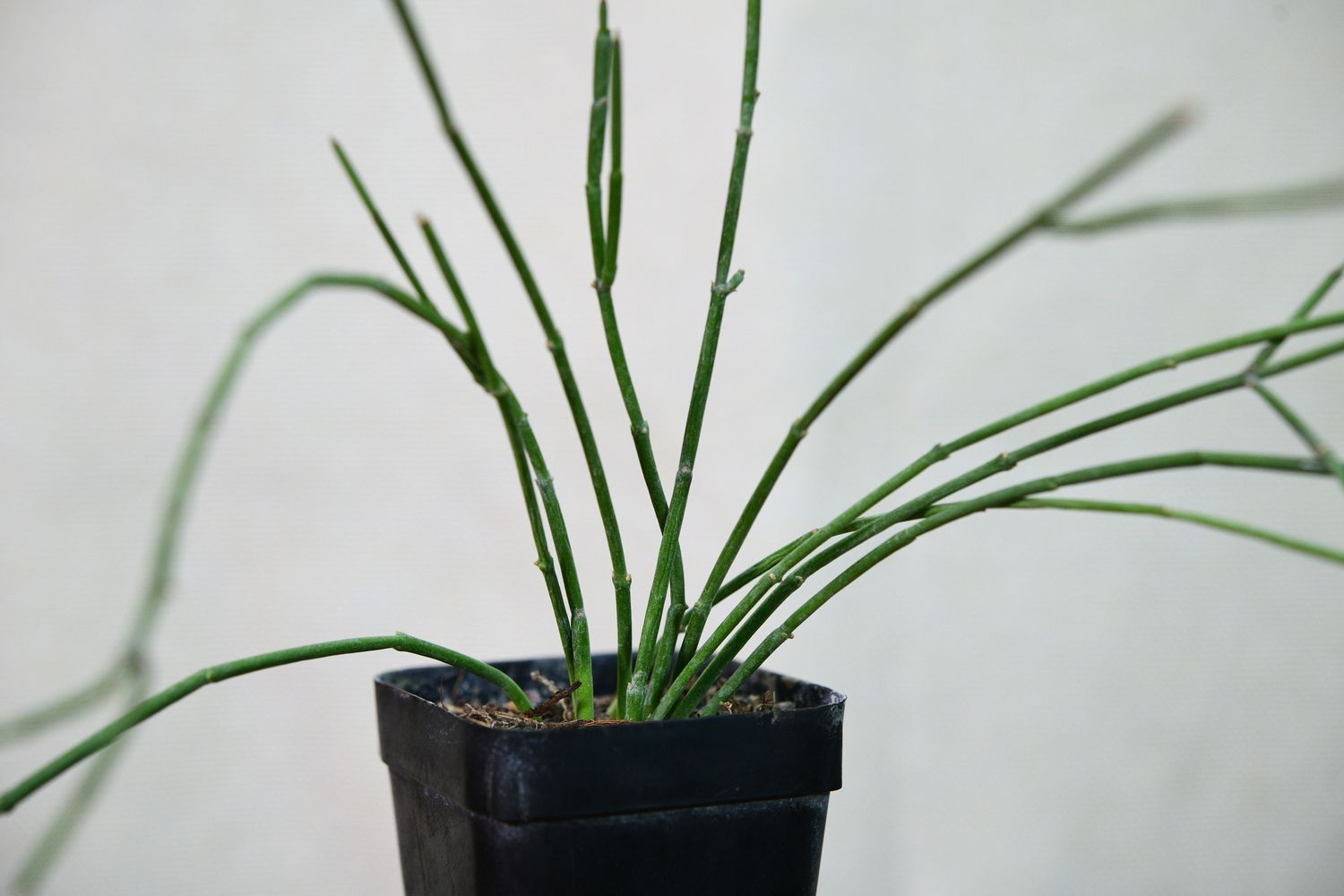
Sarcostemma vanlessenii
SKU ASC119
₹500.00
Sold out
Sold out
Save this product for later
Customer reviews
Reviews only from verified customers
No reviews yet. You can buy this product and be the first to leave a review.
Sarcostemma vanlessenii
Product Details
*A leafless, wiry succulent shrublet from the Horn of Africa and southern Arabia — its slender green stems do the work of leaves, trailing outward before breaking into small clusters of quietly elegant purple flowers each summer.*
Origin of Name
The genus name *Sarcostemma* derives from the Greek *sarkos* ("flesh") and *stemma* ("garland" or "crown"), referring to the fleshy, ring-like corona at the centre of the flower characteristic of the group. This species was formally described in 1974 by the Greek-South African botanist John J. Lavranos in the *Cactus and Succulent Journal*, based on material collected near Al Madhan on the Audhali Plateau of South Yemen — a locality still cited on collection labels for the species today (ISI 984). The species epithet honors a collector or associate surnamed Van Lessen, though the exact individual is not well documented in available sources. In 2008, botanist David Goyder transferred the species to *Cynanchum* as part of a broader reclassification that folded *Sarcostemma* into that older, larger genus; "*Sarcostemma vanlessenii*" remains the name most commonly used in succulent-collector circles.
Origin of Plant
Native to a broad but scattered range across the Horn of Africa and southern Arabia, including Yemen, Ethiopia, Kenya, and Tanzania, where it grows in arid, rocky terrain as part of the region's succulent flora.
Description
A compact, perennial succulent shrublet with narrow, cylindrical, leafless stems — photosynthesis takes place directly in the green stem tissue, a common adaptation among leafless Apocynaceae succulents. Stems are decumbent to trailing, reaching up to about 1 m long but only 3–4 mm in diameter, giving the plant a wiry, understated silhouette rather than a bold sculptural one. Small clusters of 4 to 8 flowers arise from the stem sides in summer, each bloom pale to dark purple with a deeply lobed corolla and a distinctive cream-to-pink corona at its centre. Flowers are followed by slender, tapering seed pods (follicles) 3–4 cm long, which split to release wind-dispersed, winged seeds.
Conservation Status
*Sarcostemma vanlessenii* (as *Cynanchum vanlessenii*) is not currently CITES-listed, unlike many succulents from arid Africa and Arabia, and nursery stock can be traded freely. Specific IUCN Red List assessment data is limited for this species; as with most range-restricted arid-land succulents, choosing nursery-propagated material over wild-collected plants remains the more responsible choice.
Care
**Light:** Bright light to full sun suits this species well, reflecting its native arid habitat.
**Watering:** Moderate water during the growing season, allowing the soil to dry out between waterings; reduce significantly in winter to avoid stem rot.
**Soil:** A very free-draining mineral mix, as used for other succulent Apocynaceae — standard cactus mix cut with extra grit works well.
**Temperature:** Not frost-hardy; protect from temperatures near or below freezing, and bring container specimens under cover well before cold weather arrives.
**Handling note:** Like many members of the genus, the stems contain a milky latex that can be irritating to skin and eyes in some species — handle cuttings with care and wash hands after pruning.
A Story Worth Telling
*Sarcostemma vanlessenii* is a small footnote in a much larger taxonomic story: the entire genus *Sarcostemma*, once home to dozens of species scattered from Africa to the Americas to Australia, was shown through molecular studies to be nested squarely inside the older, more established genus *Cynanchum* — itself named from the Greek for "to strangle a dog," a reference to the toxicity some of its relatives hold for canines. The 2012 reclassification folded the whole group into *Cynanchum*, but among growers and collectors, "Sarcostemma" persists as the name on the label, a small act of botanical nostalgia for a genus that technically no longer exists.
You May Also Like
New
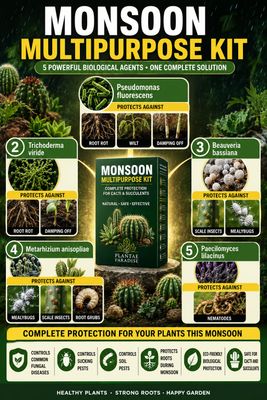
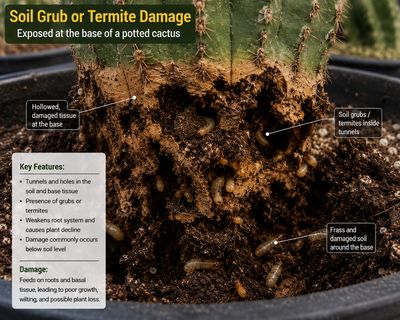
Monsoon Guardian Kit (5 in 1)
Monsoon Guardian Kit (5 in 1)
Complete 5-in-1 biological protection kit for cacti & succulents
SKU MNS024
₹850.00
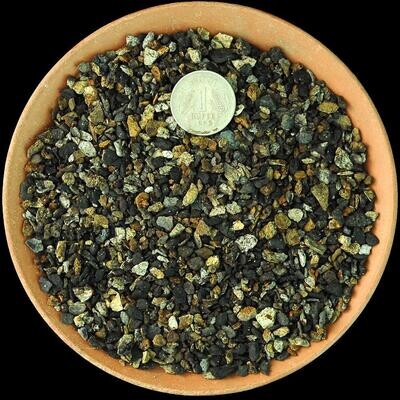
Cactus & Succulent Planting Mix COARSE (aka Cactus Soil Mix or Succulent Soil Mix)
Cactus & Succulent Planting Mix COARSE (aka Cactus Soil Mix or Succulent Soil Mix)
Washed, Free-Draining Mineral Mix for Cactus & Succulents
SKU MNS003
5.0
(1)
₹44.85
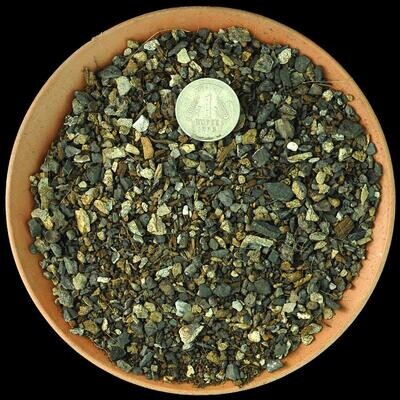
FORTIFIED Cactus & Succulent SOIL (COARSE)
FORTIFIED Cactus & Succulent SOIL (COARSE)
SKU MNS004
5.0
(12)
₹54.85
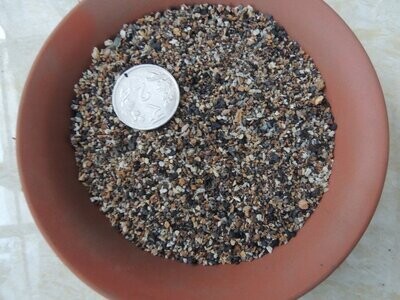
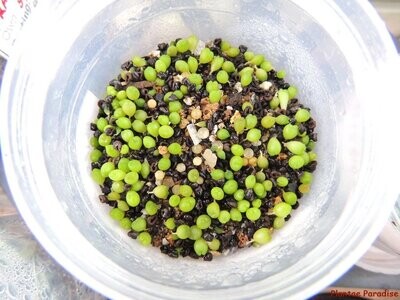
Cactus Seed Planting Mix
Cactus Seed Planting Mix
Sterile, Fine-Grain Media for Cactus & Succulent Seeds
SKU MNS005
₹74.85
Display prices in:INR
